CPA Networks
 Ad Networks
 Affiliate Programs
 Offer base




Indonesia stands out in global gambling industry trends as a market where demand remains high despite strict regulation. Instead of steady growth, the iGaming sector here moves in cycles shaped by sports events, payment access, and enforcement pressure.
This guide comes from AffRoom — a platform built for affiliates, ad networks, and iGaming specialists. It combines verified listings, practical insights, and real market data to help navigate complex GEOs like Indonesia.
All the data on gambling trends in Indonesia is provided by Blask — an all-in-one analytics platform built specifically for the iGaming industry. It delivers real-time insights into player behavior, market volume, and competitive dynamics.
Right now, current gambling market trends show a pretty clear picture: traffic surges during big sports events and holidays, and then crashes when regulatory pressure starts to build up. So, online gambling trends in Indonesia really get driven more by how easy it is to access things, and less by actually innovating new products.

Overview of the Gambling Market in Indonesia
Indonesia is one of the largest untapped iGaming markets in South East Asia, but it operates under a constant cloud of regulatory pressure. This creates a one of a kind environment where gambling market trends are shaped by things other than the usual growth factors, more like access, timing, and external triggers.
Market Snapshot (based on Blask data)
- Average market activity level: ~6.8M
- Peak activity: ~8.9M (August 2025)
- Lowest point: ~6.1M (September–October 2025)
- Recovery level: ~6.7–6.9M (early 2026)
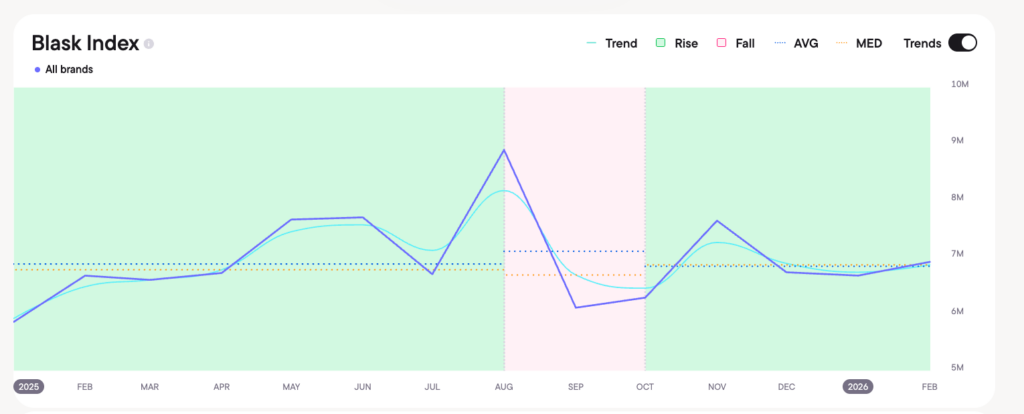
These numbers show the overall level of engagement across the online ecosystem, not just deposits or revenue. The key thing to take away is that the market is big, it’s active, but it’s also super unpredictable.
Key Market Characteristics
| Factor | Reality in Indonesia |
| Legal status | Gambling is restricted, market operates in grey/illegal segment |
| Market type | Fully online (no legal offline infrastructure) |
| Growth model | Event-driven, not linear |
| Main traffic driver | Sports (football, international tournaments) |
| Conversion bottleneck | Payments and account blocking |
| Volatility level | High (sharp rises and drops within months) |
What Defines Gambling Trends in Indonesia
Unlike more established regions, gambling trends here aren’t driven by new platform features or casino game releases. The market instead reacts to what’s happening in the world:
- Sports calendar → drives traffic spikes
- Holidays & bonuses → increase player activity
- Regulation → reduces access and payments
- Channel shifts → restore traffic after crackdowns
It all creates a pattern which looks a bit wonky on the surface, but actually makes perfect sense once you understand the underlying logic.
Why the Market Doesn’t Behave Like a Typical iGaming GEO
In most regions, iGaming market trends are tied to:
- product improvements
- brand competition
- marketing scale
In Indonesia, the situation is different:
- Demand already exists
- Traffic depends on timing
- Revenue depends on payment availability
So for operators and affiliates, it’s not so much about fighting for user interest, as it is about getting your hands on some accessible traffic and a working funnel.

Key Gambling Industry Trends in Indonesia
Right now, current trends in the gambling industry in Indonesia are all about external pressure, shifting user behaviour, and not much else. Based on Blask data, the market follows a pretty predictable pattern, where growth, decline, and recovery are all driven by a handful of consistent factors.
Below are the key trends in the gambling industry shaping the market in 2026.
1. Event-Driven Growth Dominates the Market
The sports calendar is by far the biggest driver behind the trends in Indonesia’s gambling market.
Traffic and engagement really take off during:
- Major football tournaments like the Premier League and Champions League
- Regional competitions
- Big international events that really grab local interest
These periods create predictable spikes in activity, with market levels reaching up to around 8.9 million during peak events.
Outside of these windows, things fizzle out pretty quickly, showing just how reactive user demand is — it’s a far cry from steady, consistent traffic.
What this means:
- Sports betting is basically the entry point for most people
- Casino traffic often follows heels on the sportsbook
- Timing is everything, it’s not just about consistent traffic volume
2. Online Gambling Trends Are Highly Dependent on Holidays
Another weirdly consistent pattern across online gambling trends in Indonesia is just how much holidays and bonus periods affect the market.
Key periods include:
- Idul Fitri (March – April)
- Year-end holidays (December – January)
During these times:
- People have way more free time on their hands
- Disposable income goes up — thanks to bonuses and THR payments, etc.
- Digital activity across the board goes up too
This all leads to a noticeable boost in engagement across both betting and casino segments. But of course, this growth is only temporary — it’s all tied to the calendar
3. Regulation Is the Strongest Limiting Factor
When it comes to the Indonesian gambling market, regulation is the one thing that’s really starting to have an impact.
The authorities are getting more and more serious about:
- Blocking gambling-related websites
- Removing content from social media
- Restricting access to gambling sites through ISPs
- Targeting accounts linked to gambling activity
And the most critical thing to watch is financial enforcement:
- Bank accounts get blocked
- E-wallets get restricted
- Transactions become a real pain to deal with
4. Traffic and Distribution Are Constantly Shifting
Due to enforcement pressure, the market adapts quickly.
Operators and affiliates rely on:
- New domains and mirrors
- Alternative traffic sources
- Short-lived acquisition funnels
This creates fragmented traffic flows and unstable funnels.
As a result:
- Long-term brand building is difficult
- Performance marketing becomes short-cycle
- Traffic quality varies significantly
This behavior is now a core part of iGaming trends in Indonesia.
5. Market Volatility Is Structural, Not Temporary
One of the biggest misconceptions is that market drops are anomalies.
Blask data shows a clear cycle:
- Growth phase → driven by sports and holidays
- Decline phase → caused by enforcement and payment blocking
- Recovery phase → enabled by adaptation and new channels
Summary of Key Trends
- Sports drives demand
- Holidays amplify activity
- Regulation limits monetization
- Payments control revenue
- Traffic constantly shifts
Putting all these factors together, they really define what the gambling industry trends in Indonesia look like.
Sports Gambling Trends in Indonesia
When it comes to current sports gambling trends in Indonesia, one trend stands out like a sore thumb: sports is the number one driver of short-term market growth.
According to Blask data, the biggest spikes in activity were all linked to football and other major sports events, not to new casino releases or product changes. That makes sports betting the real driver of attention, traffic and short-term conversion across the market.
Why Sports Has the Strongest Impact
Sports works so well in Indonesia because it creates repeatable traffic waves. Users don’t need some new product launch to get engaged — they react to a match calendar they already follow.
According to the timeline in the report, the strongest sports-related growth periods were all tied to:
- December 2024: ASEAN Mitsubishi Electric Cup group stages
- March 2025: Champions League knockout stage
- June 2025: Indonesia Open in Jakarta
- June–July 2025: FIFA Club World Cup
- Late December 2025–January 2026: Premier League festive schedule and Champions
Quick View: What Drives Sports Betting Activity
| Driver | Effect on the Market |
| Premier League and UCL matches | Consistent traffic and repeat engagement |
| Local and regional tournaments | Stronger local interest and betting intent |
| Dense festive match schedules | More sessions and longer user activity |
| Payment restrictions | Lower conversion despite strong demand |
| Content removals and domain blocking | Reduced discoverability and weaker acquisition |
Sports betting remains one of the clearest growth engines in the current gambling trends in Indonesia, but its real value goes beyond betting itself — it shapes how traffic enters the entire iGaming ecosystem.
Online Gambling Trends: Casino & iGaming Behavior
When looking at online gambling trends in Indonesia, it’s important to separate perception from reality. Casino and iGaming activity is present and active, but it is rarely the primary driver of traffic.
Instead, current iGaming trends show that casino engagement is largely dependent on how users enter the ecosystem — and in most cases, that entry point is sports.
Casino Is a Secondary, Not Primary Driver
Unlike more mature markets, Indonesia does not show strong evidence of casino-led growth.
According to the data:
- No major casino-specific shocks or product launches drove spikes
- Growth periods were tied to sports and seasonal activity
- Casino engagement increased during broader traffic surges
In simple terms, a casino does not create demand, it captures it. This is a key difference from other iGaming market trends globally, where slots or new game releases can independently drive traffic.
How Players Actually Behave
Player behavior in Indonesia follows a clear pattern:
- Users engage during sports events
- They enter through betting-related content or interest
- A portion of them later explore casino products
This creates a flow where:
- sportsbook = entry point
- casino = monetization layer
The document suggests this dynamic but does not provide exact conversion ratios. This is an interpretation based on the relationship between sports-driven peaks and overall activity growth.
Distribution Defines iGaming Trends
Because of constant blocking:
- domains disappear
- funnels break
- traffic shifts to new channels
Result:
- short funnel lifecycle
- unstable acquisition
- weak long-term retention
This is a core pattern across iGaming trends in this geo. The Indonesian market operates in a constant cycle of disruption and recovery. After each crackdown, blocked domains are quickly replaced with new ones, and traffic gradually returns through alternative channels. The market doesn’t disappear — it relocates.
Casino vs Sports Role
| Factor | Sports Betting | Casino |
| Traffic generation | High | Low |
| Dependency on events | High | Medium |
| Stability | Medium | Low |
| Conversion potential | High (when payments work) | High (after entry) |
| Role in funnel | Entry point | Monetization |
The Impact of Regulation on the Gambling Market in Indonesia
Regulation is by far the biggest factor shaping the gambling market in Indonesia. It doesn’t reduce demand, but it does make it much harder for people to access and monetize their activity.
Enforcement now targets more than just domains and content — it’s also aimed at payments, blocking bank accounts and e-wallets that are linked to gambling. This makes it a real pain for people to make and receive payments.
Because of this, the real impact is not lower traffic, but lower conversion. People are still active, especially around sports events, but their ability to make money from their activity is seriously disrupted.
In Indonesia, regulation doesn’t put the brakes on gambling activity — it just makes it harder for people to make money from it.
Market Volatility: Why Growth Isn’t Linear
You don’t always see steady growth in the Indonesian gambling market. It’s like two steps forward, one step back. The market is driven by cycles.
Looking at Blask data, we see a pattern repeating itself:
- growth during sports events and holidays
- decline after enforcement increases
- partial recovery as new channels appear
For example, activity can rise to ~8.9M during peak periods, then drop to ~6.1M when pressure intensifies, before stabilizing again around ~6.8M.
This is not short-term fluctuation — it is the normal behavior of the market.
The key reason is that different parts of the funnel are affected at different times. Demand remains relatively stable, but access and payments change constantly. Because of that, traffic, conversion, and revenue never move in a straight line.
FAQ: What People Also Ask About Indonesian Gambling Trends
What are the main gambling trends in Indonesia?
The main gambling trends in Indonesia include strong reliance on sports-driven traffic, clear seasonal spikes during holidays, and overall market volatility. Regulation plays a central role — it doesn’t reduce demand but limits access and payments, forcing the market to constantly adapt.
Is online gambling growing in Indonesia?
Online gambling in Indonesia is growing, but it’s not long-term growth — it is more like growth in waves. Demand is always high, especially during sports events, but the activity levels fluctuate all the time because of the regulatory pressure. Growth happens in cycles and not in a smooth upward trend
What is the current state of the gambling market in Indonesia?
The market is active but unstable. It operates entirely online under strict regulation, with frequent disruptions in access, payments, and traffic sources. Despite this, user interest remains consistently strong.
How popular is sports betting in Indonesia?
Sports betting is the most popular segment in Indonesia. It drives the majority of traffic, especially around major football events, and often acts as the main entry point into the broader iGaming ecosystem.
What regulations affect gambling in Indonesia?
Regulation includes domain blocking, content removal, and restrictions on financial transactions. Banks and e-wallet providers actively block accounts linked to gambling, which directly affects deposits and withdrawals.
Conclusion
Indonesia is not a market that follows typical rules. It doesn’t grow in a straight line, and it doesn’t reward standard approaches.
At the same time, demand isn’t going anywhere. People keep betting, playing, and engaging — the only thing that changes is how they access it. That’s why understanding this market is less about spotting trends and more about knowing how it reacts under pressure and how it recovers.
That kind of insight is hard to get from surface-level reports.
At AffRoom, we focus on breaking down markets like this in a practical way — with real insights into iGaming, traffic behavior, GEO specifics, and platforms that are actually used in the industry.
If you’re working with traffic or just want a clearer view of how these markets really operate, you’ll find a lot more depth there than in a typical overview.