CPA Networks
 Ad Networks
 Affiliate Programs
 Offer base




Artificial intelligence is becoming one of the main technologies shaping online gambling. In 2026, AI is already used by casinos and sportsbooks to personalize offers, detect fraud, automate support, optimize betting odds, and improve player retention.
The biggest change is that AI tools are no longer limited to large operators. Mid-sized casinos, betting platforms, affiliate projects, and gambling brands are actively integrating AI into daily operations to stay competitive in a saturated market.
This shift is also visible in traffic management. Kadam has introduced KAI, an AI agent built into the platform, and its own MCP server for connecting Kadam with external AI tools — cutting the time it takes to analyze performance, adjust campaigns, and act on data.
This article was prepared by AffRoom — a platform focused on the iGaming industry and affiliate ecosystem. AffRoom tracks verified market trends, industry data, and gambling statistics to help readers better understand how the global casino and betting industry is evolving in 2026.

What Is AI in the Gambling Industry?
AI in the gambling industry is the use of machine learning and automated data analysis inside online casinos and betting platforms. Instead of relying only on fixed rules or manual decisions, operators use AI to process player behavior in real time and react faster.
Modern AI casino systems can analyze thousands of player signals at once: betting activity, session length, payment behavior, game preferences, device changes, and bonus usage. This allows gambling platforms to automate decisions that previously required entire support, CRM, or risk-management teams.
Today, AI for gambling is mainly used for:
- fraud detection,
- player personalization,
- betting analytics,
- retention optimization,
- customer support automation,
- responsible gambling monitoring.
For example, if a player suddenly changes betting patterns or logs in from multiple devices, the system may automatically trigger a fraud review. At the same time, another player may receive personalized bonuses based on favorite games, deposit frequency, or session activity.
In 2026, AI is no longer considered an experimental technology in online gambling. It has become part of the core infrastructure used by casinos, sportsbooks, and betting platforms to improve security, engagement, and operational efficiency.

How Casinos Use AI Technology in 2026
AI is now involved in almost every major process inside online casinos. Some systems work directly with players, while others operate in the background — analyzing risk, monitoring behavior, or optimizing revenue.
The biggest difference compared to previous years is speed. Casinos no longer wait for manual reports or support reviews. AI systems react instantly and continuously learn from new data.
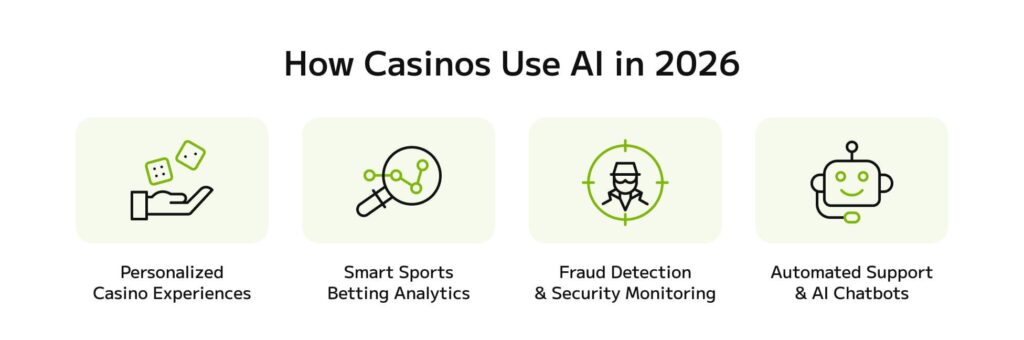
1. AI Personalization for Casino Players
Personalization is one of the most profitable uses of AI in gambling.
Instead of showing the same bonuses to everyone, casinos now adapt offers based on player behavior. The system analyzes:
- favorite games,
- deposit frequency,
- average session length,
- betting size,
- activity periods.
A sportsbook user focused on live football betting may receive reload bonuses during major matches, while a slot player may see free spin campaigns connected to preferred providers.
AI also helps casinos segment players more accurately. High-value users, bonus hunters, casual players, and users at risk of churn are now identified automatically instead of through manual CRM filtering.
2. AI-Powered Fraud Detection
Fraud prevention became one of the fastest-growing AI sectors in online gambling.
Modern AI casino systems can detect:
- multi-accounting,
- bonus abuse,
- suspicious payment behavior,
- bot traffic,
- unusual betting patterns.
For example, if dozens of accounts suddenly register from similar devices or IP ranges and follow identical deposit behavior, the platform can automatically freeze activity for review.
This is especially important for sportsbooks and crypto casinos, where fraud schemes evolve quickly and manual moderation is often too slow.
3. AI in Sports Betting
AI plays a major role in live betting operations.
Sportsbooks use machine learning models to process:
- historical statistics,
- player performance,
- live match events,
- betting volume,
- odds movement.
This helps operators adjust odds in real time and reduce exposure during high-risk events.
Some platforms also use predictive AI models to identify potentially profitable or suspicious betting behavior before large losses occur.
4. AI Chatbots and Automated Support
Customer support is becoming increasingly automated across the gambling industry.
AI chatbots now handle:
- payment questions,
- bonus issues,
- KYC instructions,
- account recovery,
- basic troubleshooting.
Many casinos use multilingual AI assistants to reduce support costs and speed up response times during peak traffic periods.
More advanced systems can also detect player sentiment. For example, if a user repeatedly contacts support after losing deposits, the system may escalate the conversation to a real manager or trigger responsible gambling checks.
Benefits of AI for Online Casinos
AI helps gambling platforms automate processes that directly affect revenue, retention, fraud prevention, and operational costs. In 2026, most large casino brands already use AI across multiple departments simultaneously.
| AI Area | How Casinos Use It | Main Benefit |
| Personalization | Dynamic bonuses, game recommendations, segmented offers | Higher retention and player activity |
| Fraud Detection | Multi-account detection, payment monitoring, abnormal behavior analysis | Reduced financial losses |
| Sports Betting Analytics | Live odds adjustments and risk balancing | Better control over sportsbook exposure |
| CRM Automation | Trigger-based emails, push notifications, retention flows | Faster player reactivation |
| Customer Support | AI chatbots and automated ticket handling | Lower support costs |
| Responsible Gambling | Detection of risky gambling behavior | Compliance and player protection |
| Marketing Optimization | Traffic quality analysis and campaign segmentation | More efficient acquisition spending |
One of the biggest advantages of AI for casinos is scalability. A platform can process millions of behavioral signals daily without increasing the size of support, analytics, or CRM teams.
AI also improves reaction speed. For example:
- suspicious payment activity can be flagged instantly;
- bonuses can be adjusted automatically based on player value;
- churn-risk users can enter retention campaigns before they stop depositing completely.
For sportsbooks, AI is especially important during live events, where odds and betting activity change every second. Manual risk management alone is no longer fast enough for large betting volumes.
Responsible Gambling and AI
Responsible gambling has become one of the fastest-growing AI sectors in the gambling industry. Online casinos and sportsbooks now use machine learning models to identify risky behavior earlier and automate player protection systems.
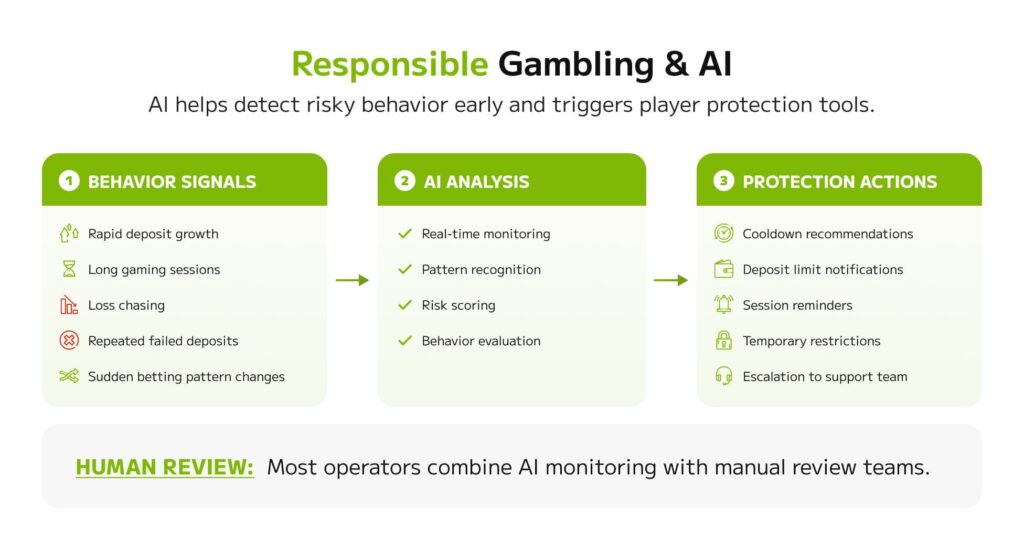
AI Detection of Problem Gambling Behavior
Modern AI gambling systems continuously analyze player activity and look for behavioral changes associated with gambling addiction or loss of control.
The most common signals include:
- rapid deposit growth,
- unusually long gaming sessions,
- aggressive loss chasing,
- repeated failed deposits,
- sudden betting pattern changes.
For example, if a player significantly increases deposit amounts after several losing sessions and continues gambling without breaks, the system may automatically flag the account for review.
Unlike manual monitoring, AI can process these signals in real time across thousands of active users simultaneously.
Automated Responsible Gambling Tools
Many AI casino platforms now connect behavioral analysis directly to automated protection tools.
Depending on the operator, AI systems can trigger:
- cooldown recommendations,
- deposit limit notifications,
- session reminders,
- temporary restrictions,
- escalation to support teams.
Some sportsbooks also adjust promotional activity automatically. If a player is identified as high-risk, the system may stop sending aggressive bonus offers or retention campaigns.
Challenges of AI-Based Monitoring
Despite rapid progress, AI is still not fully reliable in sensitive responsible gambling cases.
False positives remain a major issue. High-value players or users active during major sports events may naturally show aggressive betting behavior without having gambling problems.
Because of this, most operators combine AI monitoring with manual review teams, especially when account restrictions or intervention decisions are involved.
4 Fresh AI Casino Trends in 2026
AI adoption in online gambling is moving beyond basic automation. In 2026, casinos and sportsbooks are increasingly using AI to manage marketing, retention, player analytics, and operational workflows in real time.
1. Generative AI in Casino Marketing
Generative AI is becoming a standard tool for gambling marketing teams.
Operators use AI to:
- create ad copy,
- generate banner variations,
- localize campaigns,
- write CRM emails,
- adapt landing pages for different geos.
This is especially useful for affiliate campaigns and sportsbook promotions, where marketing materials need constant updates during live events or seasonal traffic spikes.
Some platforms also test AI-generated bonus descriptions, push notifications, and personalized retention messages based on player behavior.
2. Predictive Analytics and Retention Automation
Retention systems are becoming increasingly AI-driven.
Instead of launching the same campaigns for all users, casinos now use predictive analytics to estimate:
- churn probability,
- deposit potential,
- player lifetime value,
- reactivation chances.
For example, if the system predicts that a player is likely to stop depositing within the next few days, the casino can automatically trigger:
- cashback offers,
- free spins,
- personalized reload bonuses,
- VIP communication.
This allows operators to react before the player becomes inactive.
3. AI Voice Assistants and Customer Communication
Some gambling platforms are experimenting with AI voice technology and conversational assistants.
The main goal is faster interaction with players without expanding support teams. AI assistants are already used for:
- onboarding,
- payment guidance,
- bonus explanations,
- account verification support.
Multilingual AI communication is also becoming important for international casino brands working across dozens of geos simultaneously.
4. AI in Casino Game Development
Game studios are also integrating AI into development processes.
AI tools help developers analyze:
- player engagement,
- volatility preferences,
- session duration,
- bonus interaction rates.
This data is used to optimize game mechanics and identify which features improve retention.
Some gambling software providers are also testing adaptive gameplay systems where bonus frequency or in-game recommendations change dynamically depending on player behavior.
Challenges and Risks of AI in Gambling
AI improves automation and analytics, but it also creates new risks for gambling operators. As casinos rely more heavily on machine learning systems, problems related to privacy, regulation, and decision accuracy become harder to control.
One of the biggest concerns is data collection. AI gambling platforms process large volumes of behavioral information, including deposits, betting patterns, session activity, and device data. In regulated markets, this creates additional pressure around compliance and player privacy.
Another issue is decision accuracy. AI fraud detection systems can mistakenly flag legitimate players, especially during major sports events or high-volume betting periods. Aggressive bettors, VPN users, or players making rapid deposits may sometimes trigger automated security checks even without violating platform rules.
The industry is also facing growing regulatory attention. European regulators are increasingly focused on how AI systems influence:
- player profiling,
- bonus targeting,
- responsible gambling decisions,
- automated restrictions.
At the same time, over-automation creates operational risks. Many casinos still require human teams for VIP communication, dispute resolution, compliance reviews, and complex fraud investigations. Fully automated systems may reduce costs, but they can also negatively affect player trust if decisions appear unfair or inconsistent.
| AI Risk | How It Affects Casinos |
| False fraud detection | Legitimate players may face restrictions or delayed withdrawals |
| Data privacy concerns | Increased compliance pressure in regulated markets |
| Algorithm bias | Incorrect player segmentation or risk scoring |
| Over-automation | Poor customer experience and weaker trust |
| Regulatory scrutiny | Additional legal and compliance risks |
| AI dependency | Reduced manual oversight in critical operations |
The Future of AI in Online Gambling
AI is becoming a core part of casino and sportsbook infrastructure. In the next few years, operators are expected to automate even more processes connected to retention, betting analytics, and player engagement.
One of the main trends is dynamic personalization. Casinos are moving away from fixed bonuses toward AI-generated offers based on real-time player behavior.
Predictive analytics is also developing quickly. Operators already use AI to estimate:
- churn probability,
- player lifetime value,
- reactivation chances.
Sportsbooks continue investing in automated odds and risk-management systems capable of reacting instantly during live events.
Another growing area is AI-assisted game development. Studios increasingly use player analytics to optimize game mechanics, volatility, and engagement features.
At the same time, stricter regulation is expected around:
- player profiling,
- data privacy,
- AI-driven decision-making,
- responsible gambling automation.
FAQ
How is AI used in the gambling industry?
AI in the gambling industry is used for player personalization, fraud detection, betting analytics, customer support automation, and responsible gambling monitoring. Online casinos and sportsbooks analyze player behavior in real time to automate decisions and improve operational efficiency.
How do casinos use AI technology?
Casinos use AI technology to personalize bonuses, recommend games, detect suspicious activity, automate CRM campaigns, and optimize player retention. Many platforms also use AI-powered chatbots and predictive analytics systems to improve customer support and engagement.
Can AI improve player engagement in gambling?
Yes. AI helps gambling platforms create more personalized experiences based on player behavior, game preferences, deposit activity, and session history. This allows casinos to deliver more relevant offers, promotions, and recommendations.
Is AI used for fraud detection in casinos?
Yes. Modern AI casino systems are widely used for fraud detection. They can identify multi-accounting, bonus abuse, suspicious payment activity, bot traffic, and unusual betting patterns much faster than manual moderation systems.
What are the benefits of AI in online gambling?
The main benefits of AI in online gambling include:
- improved personalization,
- faster fraud detection,
- automated customer support,
- better betting analytics,
- stronger player retention,
- more efficient marketing automation.
Conclusion
AI is becoming one of the main technologies driving the gambling industry in 2026. Online casinos and sportsbooks already use AI for personalization, fraud detection, betting analytics, automation, and player retention.
As competition continues to grow, AI for casinos is turning from an optional tool into a core part of modern gambling operations.
This research was prepared by AffRoom — a platform covering iGaming trends, gambling analytics, and affiliate industry insights.