CPA Networks
 Ad Networks
 Affiliate Programs
 Offer base




Picking one of the top proxy services in 2026 means cutting through a crowded market where every provider claims enterprise-grade pools and bulletproof rotation. Here are 11 best proxies across residential, datacenter, ISP, and mobile types, with real pool sizes, pricing, and a decision framework to help you pick by workload, not by brand name.
This roundup is part of AffRoom’s ongoing coverage of the infrastructure affiliates and media buyers run on — proxies, antidetect browsers, and payment tools included. AffRoom’s Tools section catalogs and reviews the providers behind that stack, so you can compare options and connect with vendors directly instead of piecing it together from forum threads.
Running multiple accounts alongside your proxy setup? Pair this with our guide on managing multiple accounts without getting banned — proxies are only half of the anti-detection stack.
What this article covers:
- 11 provider profiles — proxy types, rotation model, pricing, pros, cons
- A proxy type primer — residential, datacenter, ISP/static residential, mobile 4G/5G
- A comparison table of all 11 top proxy providers
- Use-case shortlists — scraping, ad verification, SEO, drops, social media, QA
- A buyer’s checklist

How We Ranked the Best Proxy Services in 2026
This ranking is editorial, not a live benchmark — we didn’t run our own latency or success-rate tests, since those shift by target and time of day. Instead, we cross-checked each provider’s official pricing pages and independent reviews as of July 2026, and flagged cases where numbers for the same provider disagree between sources — which happens more often than you’d expect in this market.
Evaluation criteria:
| Criterion | Why it matters |
|---|---|
| Proxy types offered | Fit for use case — residential vs. mobile vs. ISP vs. datacenter |
| Geo granularity | City- and ASN-level targeting affects scraping precision and ad verification |
| Rotation and session control | Sticky vs. rotating sessions change task suitability |
| Pricing model transparency | Per-GB, per-IP, and subscription models suit different workloads |
| Integration tooling | APIs, extensions, and unlocker layers reduce engineering cost |
| Compliance posture | Consented IP sourcing and GDPR alignment reduce legal risk |
| Support and trial availability | Onboarding friction and pilot options matter at scale |

Proxy Types Explained: Residential, Datacenter, ISP, and Mobile
Match the proxy type to your use case first — it determines cost and your odds of avoiding a ban.
Residential proxies
IPs are assigned by internet service providers to real home users, so they carry a high trust score with most anti-bot systems. Priced per GB, they’re the most expensive proxy type after mobile. Rotation is usually automatic, with sticky sessions configurable from a few seconds up to 20–30 minutes.
Datacenter proxies
IPs come from cloud or colocation servers rather than consumer ISPs — fast, cheap, and available in bulk, the default for high-volume tasks with low detection risk. Datacenter ranges are well-known and frequently blocked on major e-commerce, search, and social targets. Priced per IP or subnet, often by subscription.
ISP / static residential proxies
These combine residential trust with datacenter stability: the IP is assigned by a real ISP but hosted on a server, so it stays fixed across sessions. That fits account management, long login sessions, ad verification from a fixed location, and checkout automation. Many teams pair a static IP per profile with an antidetect browser for a consistent fingerprint, not just a consistent IP. Priced per IP per month.
Mobile 4G/5G proxies
Traffic runs through SIM-based connections on real carrier networks. Mobile IPs get the highest trust score of any proxy type since they’re shared among many users and rotated by carriers themselves — but they’re also the most expensive per GB, with the lowest throughput. Use them when a platform specifically flags datacenter and residential IPs, a common case for managing several social media accounts safely at once.
When to use each type:
| Proxy Type | Trust Score | Speed | Relative Cost | Best Use Case |
|---|---|---|---|---|
| Residential | High | Medium | High (per GB) | Scraping, ad verification, SERP tracking |
| Datacenter | Low–Medium | High | Low (per IP) | High-volume scraping on low-security targets |
| ISP / Static Residential | High | High | Medium (per IP/month) | Account management, long sessions, geo QA |
| Mobile 4G/5G | Highest | Low–Medium | Highest (per GB/port) | Social automation, carrier-locked targets |
Decision flow: high-security target + carrier-locked platform → mobile. High-security target + rotating traffic → residential. High-security target + persistent identity → ISP. Low-security target + volume → datacenter. Then match the pricing model to your workload shape — bandwidth-heavy vs. IP-count-heavy.
Comparison Table: 11 Top Proxy Providers at a Glance
| Provider | Proxy Types | Pool Size (as published/marketed) | Pricing From | Best For |
|---|---|---|---|---|
| Bright Data | Residential, Datacenter, ISP, Mobile | 400M+ residential (vendor-claimed) | $5.88/GB (residential) | Enterprise scraping, full proxy stack |
| Oxylabs | Residential, Datacenter, ISP, Mobile | 100M+ residential (official page); marketing cites 175M+ | $4/GB (residential) | Large-scale data collection, compliance-first |
| Decodo (formerly Smartproxy) | Residential, Datacenter, ISP, Mobile | 115M+ residential | $2/GB (residential) | SMB scraping, developer-friendly onboarding |
| SOAX | Residential, Mobile, Datacenter | 155M+ residential, 33M+ mobile | $4/GB (residential/mobile) | Flexible rotation, granular geo-targeting |
| IPRoyal | Residential, Datacenter, ISP, Mobile | ~32M+ residential | $1.75/GB (residential, at volume) | Budget-conscious buyers, static IPs |
| DataImpulse | Residential, Datacenter, Mobile | 90M+ residential (first-party, opt-in sourced) | $1/GB (residential) | Budget scraping, ethical sourcing, no subscription |
| Rayobyte | Datacenter, Residential, ISP, Mobile | 300,000+ datacenter IPs (9 ASNs); residential cited 30–40M+ | ~$0.20/IP (datacenter) | Datacenter-first workloads, ethical sourcing |
| Webshare | Datacenter, Residential, ISP | 80M+ residential, permanent free tier | $0.05/IP (datacenter) / $1.40/GB (residential) | Entry-level use, free tier available |
| ProxyEmpire | Residential, Mobile, Datacenter | ~9M+ residential/mobile | $3.50/GB (residential, promo) | Mobile proxy access, rotating 4G/5G |
| Nimbleway | Residential, ISP + Scraping API | Not published separately from the API | $8/GB (proxy) | Scraping API + proxy hybrid, JS rendering |
| Infatica | Residential, Datacenter, Mobile | 10–40M+ residential (figures vary by source) | ~$1/GB (at volume) | Mid-market, GDPR-compliant sourcing |
Pool sizes, country counts, and $/GB figures vary by source and change often — Bright Data alone has been cited anywhere from 72M to 400M+ residential IPs depending on the page. Confirm current numbers on the provider’s own pricing page before committing budget.
The 11 Best Proxy Services in 2026, Reviewed
Here’s the full lineup, starting with the largest player on the market.
1. Bright Data
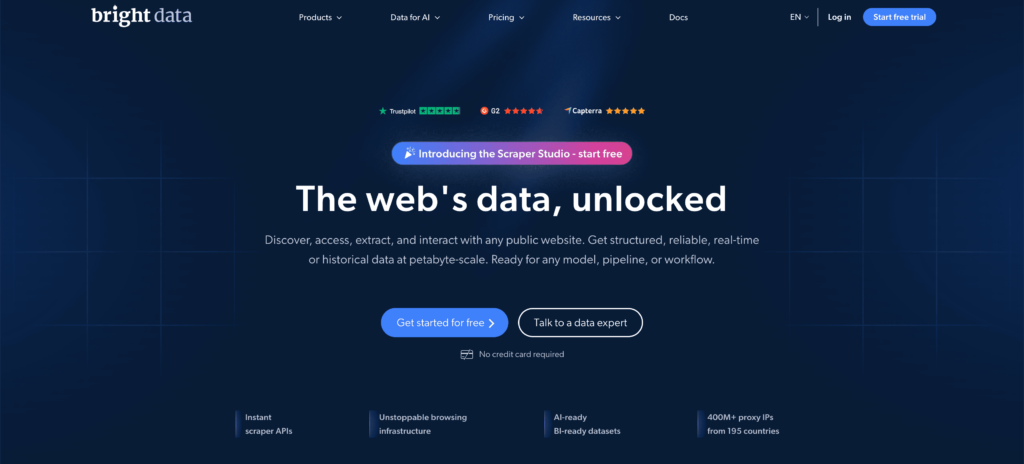
The largest commercial proxy network on the market, grown out of Luminati Networks (founded 2014). Officially advertises 400M+ monthly IPs across 195 locations, with targeting down to city, ZIP code, ASN, and mobile carrier. Beyond raw proxies, it bundles a Scraping Browser, a Web Unlocker API, and a dataset marketplace — a full data infrastructure stack, not just a proxy reseller.
Pricing starts at $5.88/GB for residential; ISP (static residential) starts at $13.13/GB, datacenter far cheaper. Independent reviews put the customer base above 20,000 organizations, reportedly crossing $300M in annual recurring revenue in 2025. Best for: teams that want one vendor across every proxy type and can handle a more involved onboarding process.
Pros: full proxy stack, mature scraping tooling, strong compliance posture.
Cons: expensive at scale, complex pricing tiers, residential/mobile access requires business KYC.
2. Oxylabs
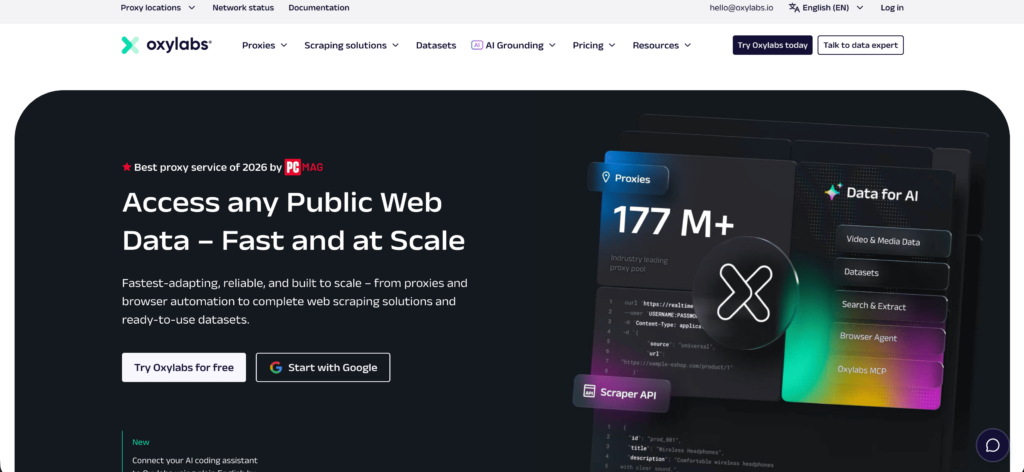
A Lithuanian provider (founded 2015, Vilnius) that leans on compliance and data quality over raw pool size. The official product page lists 100M+ residential IPs across 195 locations with country, state, city, and ZIP-code targeting; marketing material and some reviews cite 175M+ — worth double-checking before committing to volume.
Runs a Web Scraper API and managed scraping tools for teams that don’t want their own parsing layer. Entry pricing starts at $4/GB pay-as-you-go for residential; ISP proxies from $1.60/IP. Best for: compliance-conscious enterprise buyers who need documented IP-sourcing ethics.
Pros: documented ethical sourcing, full proxy type coverage, managed scraping layer.
Cons: premium pricing, some products still require a sales call.
3. Decodo (formerly Smartproxy)
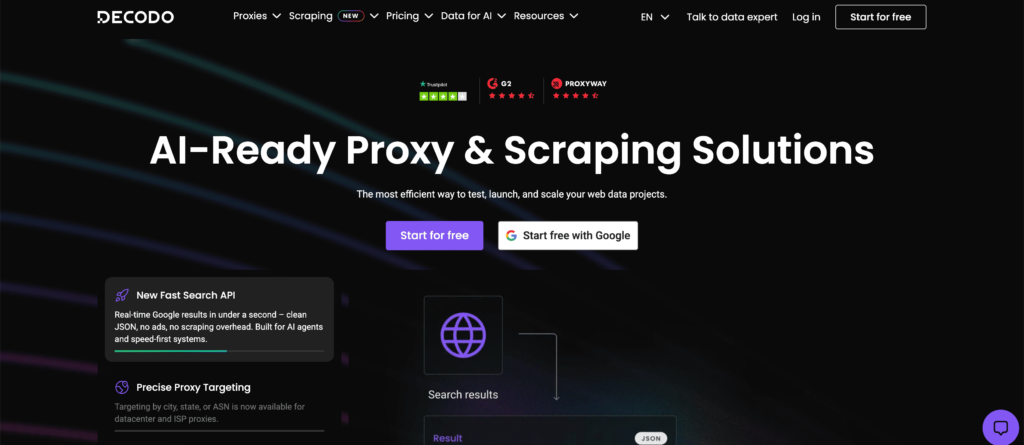
The new name for Smartproxy after an April 2025 rebrand — same infrastructure and team, new dashboard. Advertises 115M+ residential IPs across 195+ locations with city, state, and ZIP-code targeting, with a genuinely self-serve signup.
Pricing starts at $2/GB on volume plans (entry pay-as-you-go closer to $4/GB), undercutting Bright Data and Oxylabs by a wide margin. Independent testing regularly hands Decodo Proxyway’s best-value awards, with success rates around 99.8%+. If you’re also running anti-detect browser profiles, our Dolphin Anty review covers a proxy manager that pairs well here. Best for: developers and small teams that want the full type menu without enterprise overhead.
Pros: developer-friendly dashboard, accessible entry pricing, full proxy type coverage.
Cons: smaller network scale than top-tier enterprise providers.
4. SOAX
Focuses on residential and mobile proxies with an emphasis on geo-precision and rotation flexibility. The official site lists 155M+ residential IPs; Proxyway’s review separately confirms 33M+ mobile IPs with carrier-level targeting (T-Mobile, AT&T, Verizon, Vodafone, and others). Fact-check: per that same review, SOAX discontinued its standalone ISP proxy product in late 2025 — for static residential, look at IPRoyal or Decodo instead.
Pricing starts at $4/GB on the Starter tier, dropping to roughly $2/GB on high-volume plans; no pay-as-you-go option. Best for: ad verification teams and SEO agencies that need city- and ASN-level precision.
Pros: granular geo-targeting, real-time IP health monitoring, wide protocol support (SOCKS5, UDP, QUIC).
Cons: no ISP proxy product since late 2025, no pay-as-you-go plan.
5. IPRoyal
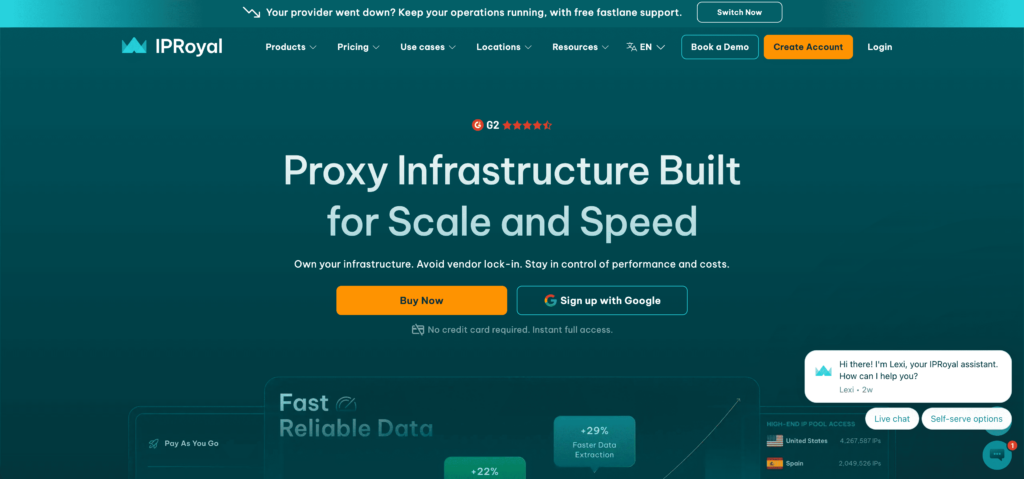
One of the more accessible providers on price, with a pool of roughly 32M+ residential IPs across 195+ countries. Its static residential (ISP) product is popular for persistent IPs below premium pricing — from $2.40/IP/month; datacenter from $1.39/IP.
Residential traffic starts at $7/GB on entry, dropping to $1.75/GB at bulk volume, and purchased bandwidth never expires — rare in this market. Part of the pool is sourced through IPRoyal’s own program, Pawns.app, where users opt in to share bandwidth for a reward. Best for: budget-conscious buyers and drop automation, where a stable IP per account matters as much as the virtual cards funding each checkout.
Pros: competitive pricing, traffic never expires, consent-based sourcing.
Cons: pool noticeably smaller than Bright Data or Oxylabs.
6. DataImpulse
A younger provider (founded 2022, based in St. Petersburg, Florida) that’s built its own first-party residential pool from scratch rather than reselling someone else’s network — IPs are sourced through an opt-in bandwidth-sharing app, with users compensated for sharing a portion of their traffic. The pool sits at 90M+ residential IPs across 195 countries, with country, state, city, and ASN targeting included at no extra cost.
Pricing undercuts almost the entire market: residential starts at $1/GB pay-as-you-go with no subscription, dropping to around $0.80/GB at 1,000GB+ volume; datacenter is $0.50/GB, mobile $2/GB, and a filtered premium residential tier runs $5/GB. Purchased traffic never expires. The provider has picked up Proxyway’s Newcomer of the Year and Greatest Progress awards in back-to-back years and holds a 4.8/5 rating on G2. Best for: budget-conscious scraping and SERP tracking where a younger, first-party network is an acceptable trade-off for the price.
Pros: lowest entry price in the market, no subscription or expiring traffic, transparent opt-in sourcing.
Cons: no SOC 2 or ISO 27001 certification yet, thinner pool depth in tier-3 geographies than Bright Data or Oxylabs, weaker success rates against the toughest anti-bot targets.
7. Rayobyte
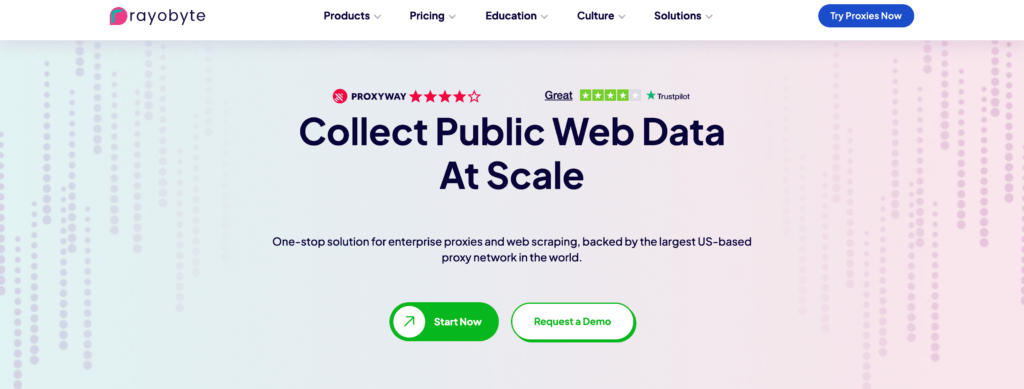
A US-based provider (founded 2015 as Blazing SEO, rebranded 2022) built around ethical sourcing and transparency, especially on its datacenter product. Independent reviews put the datacenter network at roughly 300,000+ dedicated IPs across 9+ ASNs. The residential pool is cited anywhere from 30M to 40M+ IPs depending on source — no single figure is fixed on the official site, so confirm current numbers directly before committing to volume.
Datacenter starts around $0.20–1/IP depending on plan, ISP from $1.79/IP, residential from roughly $1–4/GB. Residential and mobile traffic is sourced through an opt-in bandwidth-sharing program similar to IPRoyal’s Pawns.app. Best for: datacenter-first workloads where ASN diversity and documented sourcing matter.
Pros: deep datacenter network, public sourcing policy, ISP proxies available.
Cons: residential network smaller than dedicated residential-first providers; pool figures vary by source.
8. Webshare
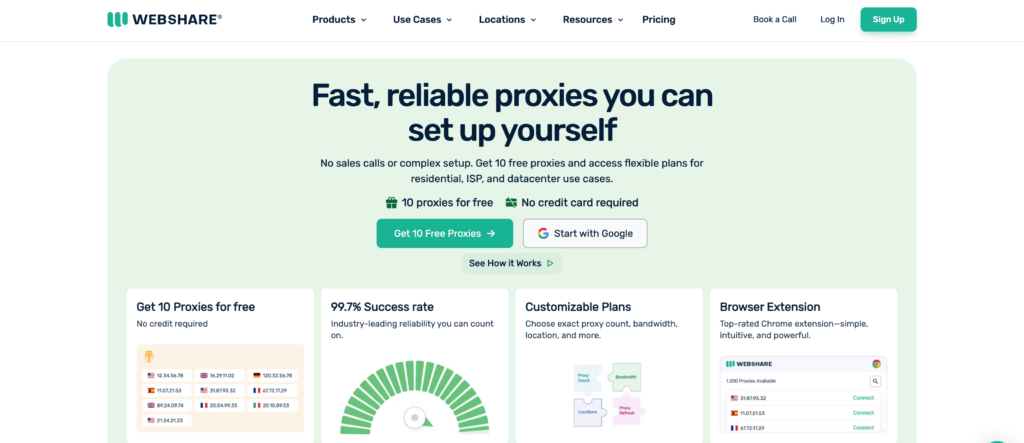
One of the few providers with a genuinely usable free tier: 10 datacenter proxies and 1GB of bandwidth per month, forever, no credit card, per its official pricing page. A practical entry point for testing before committing budget.
Paid datacenter proxies start at $0.05/IP (as low as $0.018 during promos), residential from $1.40/GB against an advertised 80M+ IP pool, ISP from $0.30/IP. No managed scraping layer and no mobile proxies in the lineup. Best for: developers, researchers, and small teams with modest bandwidth needs.
Pros: permanent free tier, simple API, low entry cost.
Cons: no mobile proxies or managed scraping layer, not built for enterprise scale.
9. ProxyEmpire
Founded 2020, headquartered in Burgas, Bulgaria — focused on mobile and residential proxy access, with rotating 4G/5G coverage across 170+ countries. Proxyway’s independent testing puts the real pool at a more modest ~9M+ IPs, though the site shows a live counter of available IPs per location before you register.
Residential lists at $7/GB, but a running promo brings it to $3.50/GB; datacenter starts at $0.35/GB. The trial costs $1.97 and unlocks 100MB residential plus 50MB mobile data, and unused bandwidth rolls over with no expiry. For social media automation, mobile carrier IPs like these hold up better against platform detection. Best for: social automation and mobile app testing needing genuine carrier IPs.
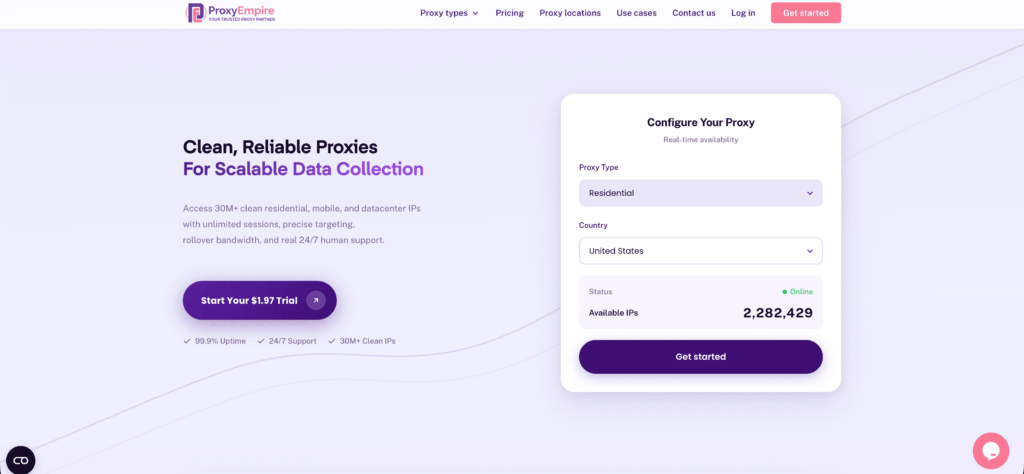
Pros: strong mobile coverage, carrier-level targeting, unlimited bandwidth rollover.
Cons: smaller pool overall, less competitive datacenter pricing, some verticals (fintech, streaming, crypto) blocked by default until KYC.
10. Nimbleway
Founded 2019 in Israel — less a standalone proxy provider and more a data-collection platform: Nimble IP (proxies), Nimble Browser (automation browser), and Nimble API (managed scraping with JS rendering) sold as one stack. The proxy layer is sourced under GDPR/CCPA, but per user reviews, buying proxies alone isn’t always straightforward.
Pricing starts at $8/GB for proxy traffic or $3 per 1,000 requests on the pay-as-you-go Scraping API tier, with up to 15% off annual plans. No standalone IP pool size is published — the network functions as an internal API component rather than a self-contained product. Best for: data engineering teams wanting a proxy and scraping API bundled together.
Pros: proxy + scraping API integration, JS rendering, less engineering overhead.
Cons: higher per-GB pricing than proxy-only providers; pool size unpublished; proxies alone not always available.
11. Infatica
Founded 2019, headquartered in Singapore — sources residential IPs through an SDK embedded in partner apps, where users opt in to share bandwidth for in-app rewards. ISO 27001-certified with a public GDPR alignment claim. Pool-size figures vary sharply by source, from roughly 10M to 40M+ IPs, so confirm the current number directly before buying volume.
Plans start at $96 for 8GB (about $12/GB) on entry, dropping toward $1/GB or lower at volume and during promotions; datacenter from $15/month, mobile from $45/month. Coverage spans roughly 195 locations with city- and ASN-level targeting. Best for: mid-market buyers needing a multi-type provider with documented compliance.
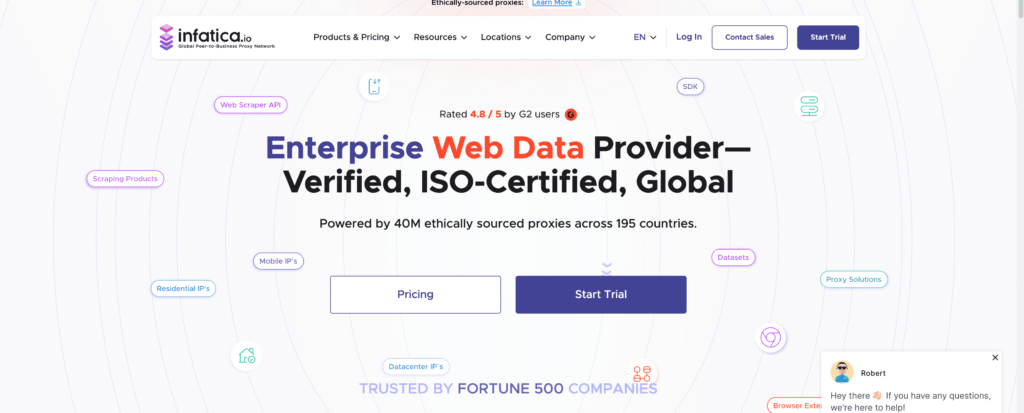
Pros: claimed GDPR alignment, multiple proxy types in one account, sub-user management.
Cons: smaller network than enterprise-tier alternatives; pool-size figures diverge between sources; fewer advanced scraping tools than the top three.
Best Proxy Service by Use Case
- Web scraping at scale. Residential (rotating) for high-security targets; datacenter for low-security ones. Shortlist: Bright Data, Oxylabs — both offer the full type menu and a managed scraping layer that cuts engineering time.
- Ad verification and brand protection. Residential or ISP with city-level targeting. Shortlist: SOAX, Oxylabs — SOAX for geo-granularity, Oxylabs for compliance documentation.
- SEO and SERP tracking. Residential (rotating) or ISP. Shortlist: Decodo, SOAX. Rotation prevents rate-limiting; ISP proxies give stability for scheduled jobs. If your stack also touches SEO tooling, our Semrush vs. Ahrefs comparison is a useful companion read.
- Sneaker, ticket, and drop automation. ISP / static residential. Shortlist: IPRoyal, Decodo — checkout automation needs persistent IPs that don’t rotate mid-session.
- Social media automation. Mobile 4G/5G. Shortlist: ProxyEmpire, IPRoyal. Social platforms flag most datacenter and many residential IPs; carrier IPs offer the highest trust score. Pair this with an anti-detect browser like AdsPower or Linken Sphere if you’re running more than a handful of accounts.
- Geo-unblocking and QA testing. ISP / static residential, or plain residential. Shortlist: Bright Data, Infatica — stable IPs in specific countries for repeatable test runs.
Buyer’s Checklist: How to Choose a Proxy Provider
- IP sourcing and ethics. Ask directly: are residential IPs sourced through an opt-in program? Is there a published opt-out mechanism? Is GDPR alignment documented? Providers publishing their sourcing policy (Oxylabs, Rayobyte, IPRoyal’s Pawns.app, Infatica) give you an auditable trail — important for regulated markets.
- Pool size and geo granularity. Pool quality and coverage of your specific targets matter more than raw size. Ask for country, state, and city-level targeting in the markets you need. Check ASN diversity for your target’s detection model — a single-ASN pool blocks more easily than a multi-ASN one.
- Rotation and session control. Match session TTL to your target’s rate-limit behavior. Sticky sessions improve login flows and checkouts but reduce IP diversity; rotating sessions maximize diversity for scraping but break stateful sessions. Confirm the sticky-session window before signing.
- Pricing model: $/GB vs. $/IP vs. subscription. Model the cost first: Estimated monthly bandwidth cost = (target pages × avg page size in KB ÷ 1,024) × $/GB Compare against: (IPs needed × $/IP/month) for static or subscription models. Bandwidth-heavy, IP-count-light workloads (bulk scraping) can scale poorly on per-GB pricing; a small number of persistent IPs (account management) is usually cheaper on per-IP subscription. Run both models against your actual workload before choosing.
- Protocols, auth, and integration. Confirm HTTP/HTTPS and SOCKS5 support. Check whether auth is username/password or IP whitelisting — whitelisting is simpler for server-side automation but needs a static egress IP. Weigh whether the API, SDK, or unlocker layer saves enough integration time to justify a higher per-GB cost.
- Support, SLA, and trial. Prioritize a free trial or money-back window — it’s the only reliable way to test pool quality on your specific targets. Check live-chat hours and whether the SLA covers proxy availability, not just platform uptime.
Free vs. Paid Proxies: Risks and When Free Is Acceptable
Free and public proxy lists are widely available, but the risks are significant for any production use case:
- Bandwidth theft and logging. Many free proxies are run by unknown operators who log your traffic — a real risk for authenticated requests or sensitive data.
- MITM exposure. Free proxies can intercept HTTPS traffic if you accept their root certificate, opening the door to credential harvesting.
- Pre-banned IPs. Public proxy IPs get scraped and blocked within hours of appearing on free lists; success rates on meaningful targets are typically very low.
- No rotation or session control. Free lists offer no programmatic rotation, making them unsuitable for automation.
When free is acceptable: low-stakes, non-authenticated tasks testing integration logic — not production targets, and with no sensitive data passing through. Webshare’s free tier is a safer alternative here: a small number of managed datacenter IPs with basic authentication.
For scraping, automation, ad verification, or account management, paid proxy services are the only viable option — the cost of a blocked IP, a leaked credential, or a failed compliance audit exceeds a legitimate subscription.
FAQ
What are the best proxy services in 2026?
It depends on your use case and proxy type. For enterprise scraping and full-stack coverage, Bright Data and Oxylabs lead. For SMB and developer use cases, Decodo and IPRoyal offer accessible pricing. For mobile carrier IPs, ProxyEmpire stands out. For ISP-grade stability, DataImpulse and Rayobyte are strong choices. There’s no single best proxy server — match the provider to proxy type, geo needs, and pricing model first.
How do proxy services work?
A proxy server sits between your client (browser, scraper, or automation tool) and the target website. Your request goes to the proxy, which forwards it to the target using its own IP and returns the response to you. The target sees the proxy’s IP, not yours. Providers maintain pools of residential, datacenter, ISP, or mobile IPs and route traffic through them, rotating a new IP per request or holding one for a defined session window.
What should you consider when choosing a proxy provider?
Proxy types offered, geo granularity (country vs. city vs. ASN), rotation and session control, pricing model fit (per GB vs. per IP vs. subscription), IP sourcing ethics and GDPR compliance, integration tooling, and trial availability. Run a cost model — (pages × avg KB ÷ 1,024) × $/GB — before comparing sticker prices, and test against your actual target before committing to volume.
Which type of proxy is best for your needs?
Datacenter for high-volume, low-security targets where speed and cost matter most. Residential for anti-bot-protected targets like e-commerce, search engines, and ad platforms. ISP/static residential for a persistent identity — account management, checkout automation, long sessions. Mobile 4G/5G for social media automation and carrier-locked targets.
Are paid proxy services better than free proxies?
For any production workload, yes, significantly. Free and public lists carry serious risks: unknown operators can log or intercept traffic, IPs get pre-banned on most meaningful targets within hours, and there’s no rotation, session control, or support. Paid services provide managed IP pools, programmatic rotation, authentication, SLAs, and compliance documentation.
Conclusion
The right proxy service starts with proxy type, not brand name. Map your use case to the type first — datacenter for speed and cost, residential for anti-bot-protected targets, ISP for persistent sessions, mobile for carrier-locked platforms — then compare providers within that type by geo granularity, rotation model, and pricing.
Run a cost model against your actual workload before comparing per-GB or per-IP sticker prices; the cheapest headline rate rarely stays cheapest at production volume, and integration depth often outweighs the per-GB delta. Published pool-size figures for the same provider can also vary several-fold between review sites — always verify on the provider’s own pricing page before committing budget.
Proxies are just one piece of a working affiliate stack. AffRoom covers the rest too — CPA networks, ad networks, and affiliate programs — and the community is a good place to compare notes with other marketers running the same setups.