CPA Networks
 Ad Networks
 Affiliate Programs
 Offer base




Video is quietly becoming the backbone of programmatic ad spend. But for affiliates and media buyers used to push and pop, it’s still an unknown beast: more formats, more sources, and a lot more terminology to untangle.
RichAds, a trusted ad network for agencies and brands built to scale CPA registrations, deposits, and KPI reach, has just published an in-depth research piece on video advertising. It breaks down exactly how video ads work and where the real opportunities sit in 2026. Spoiler: go for the iGaming vertical.
The report was authored by Alexandra Lamish, Chief Marketing Officer at RichAds, who has over 16 years of experience in digital marketing across adtech, e-commerce, hospitality, and FMCG. Lamish put the research together after noticing how often advertisers get lost the moment they move from other formats into video buying.
“Nobody needs convincing anymore that video works. What’s changed is how measurable it’s become: post-view tracking, automated rules, microbidding — video is no longer a black box between impression and deposit. It’s still a reach-and-awareness tool first, not a direct-response one, but the tracking underneath it keeps getting sharper every quarter. And AI has completely changed the game on the creative side, letting teams turn performance data into fast, large-scale creative production instead of guessing what to make next.”
— Alexandra Lamish, CMO at RichAds
Below, the AffRoom team breaks down what the research covers, along with the visuals RichAds used to illustrate the market data.

Sorting Out Video Ad Formats
The report starts by clearing up terminology, since video formats can be classified three different ways at once:
- By placement: in-stream (inside a video player) vs. out-stream (in an article, feed, or banner).
- By position in the viewing session: pre-roll, mid-roll, or post-roll.
- By user engagement model: rewarded video, interstitial video, or native video.
This gives you eight distinct formats: In-Stream, Out-Stream, Pre-Roll, Mid-Roll, Post-Roll, Rewarded Video, Interstitial Video, and Native Video. The research explains each one, laying out where it runs, what triggers it, and its pros and cons for Gambling and Betting campaigns specifically.

Four Places to Actually Buy Video Traffic
Lamish maps out the four real sources of video inventory available to advertisers:
- Mainstream video networks: clean, whitelisted publisher inventory, safe for white-hat brands.
- Non-Mainstream video networks: torrents, file-sharing, pirated streaming, with low CPM and minimal moderation. A fit for grey verticals.
- Social Video: TikTok, YouTube Shorts, Meta. Massive reach, but strict gambling policies.
- CTV/OTT: Netflix, Roku, smart TVs. Premium branding inventory, high cost, strict moderation.
Each source is matched against formats and verticals in the research, giving media buyers a clear map of which channel fits which type of campaign.
The Numbers Behind the Video Market
This is where the research gets genuinely data-heavy. Lamish pulled and cross-referenced stats from Pixalate, eMarketer, Nielsen, and RichAds platform-level data to show what’s actually happening with video traffic volumes and ad spend.
Here are four patterns worth your attention.
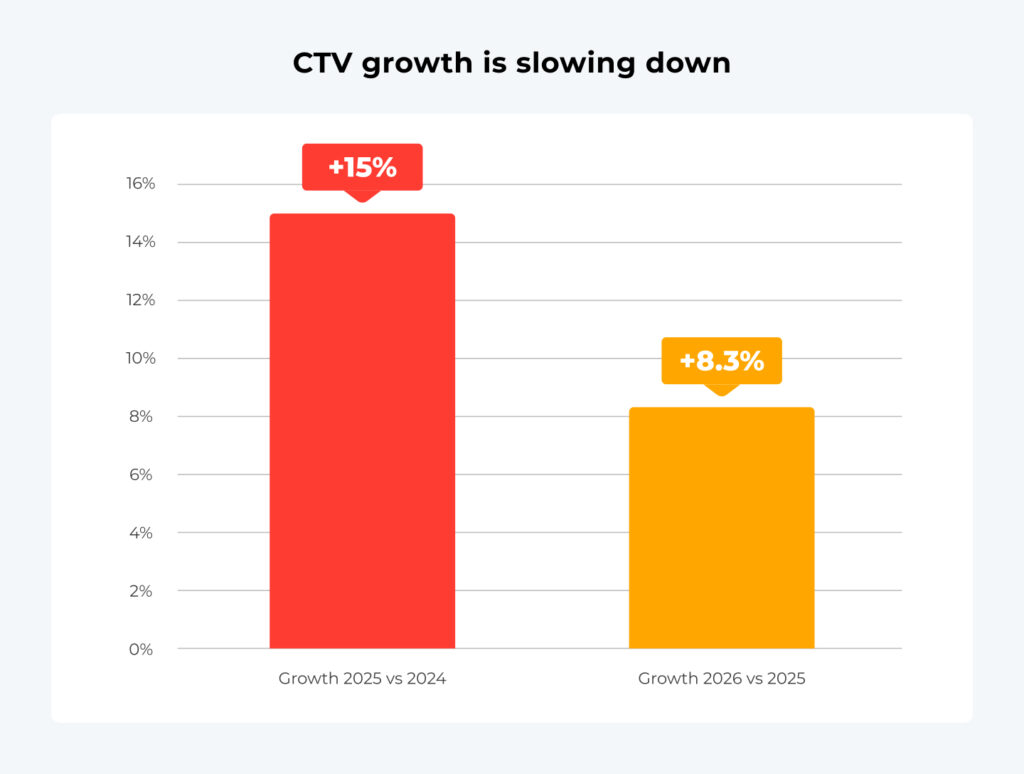
1. CTV growth is slowing down
Time spent on connected TV grew 15% in 2025 vs. 2024, but that growth is projected to slow to just 8.4% in 2026. It’s a clear sign the CTV market is moving from explosive growth into maturity.
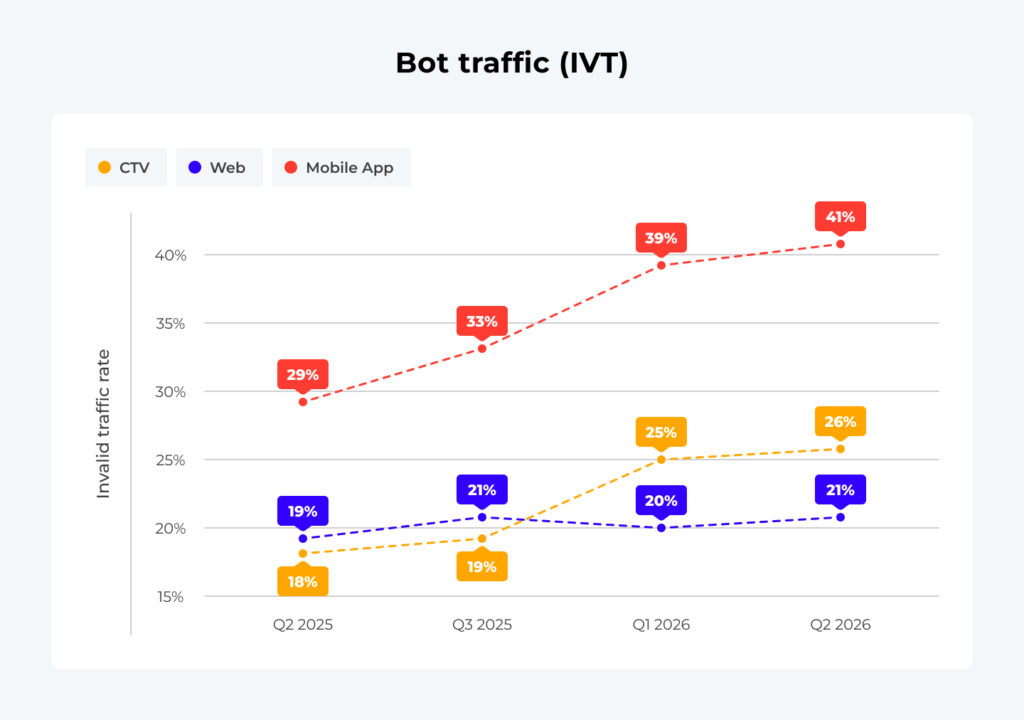
2. Bot traffic (IVT) keeps climbing, especially on mobile
Pixalate’s data shows invalid traffic on mobile apps jumped from 29% in Q2 2025 to 41% in Q2 2026, a steady, uninterrupted climb. Web and CTV IVT grew more slowly over the same period.
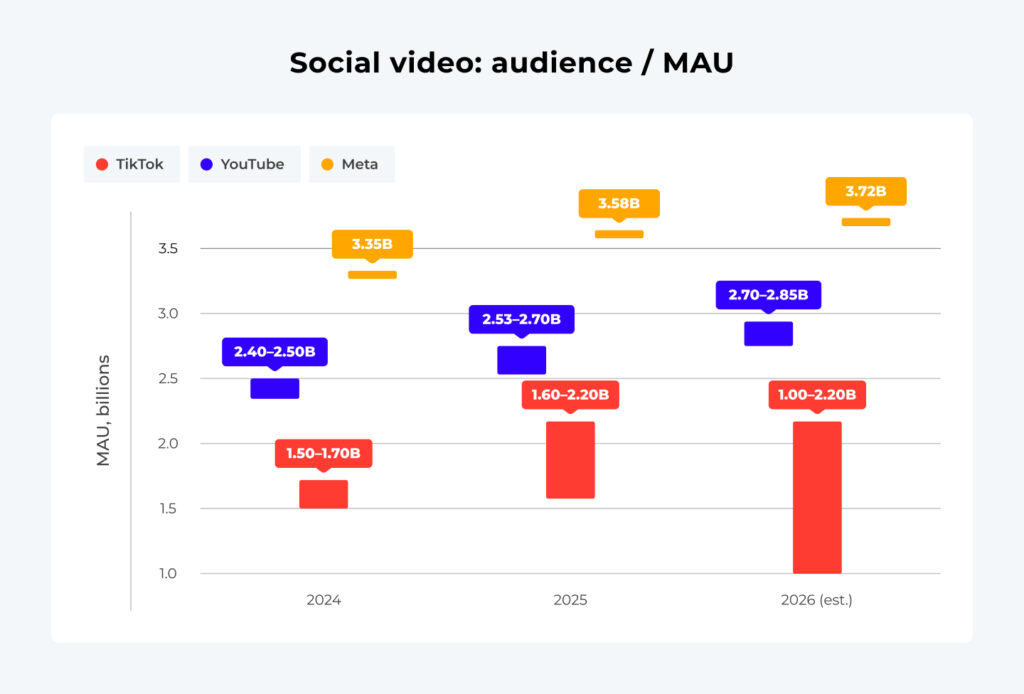
3. Social video audiences are still growing, but unevenly
- YouTube shows the most stable trajectory at 6–7% YoY.
- Meta’s growth is slowing, from +6.8% to +4% over three years.
- TikTok’s numbers look steady, but they are the least reliable of the three, since ByteDance discloses no official figures at all.
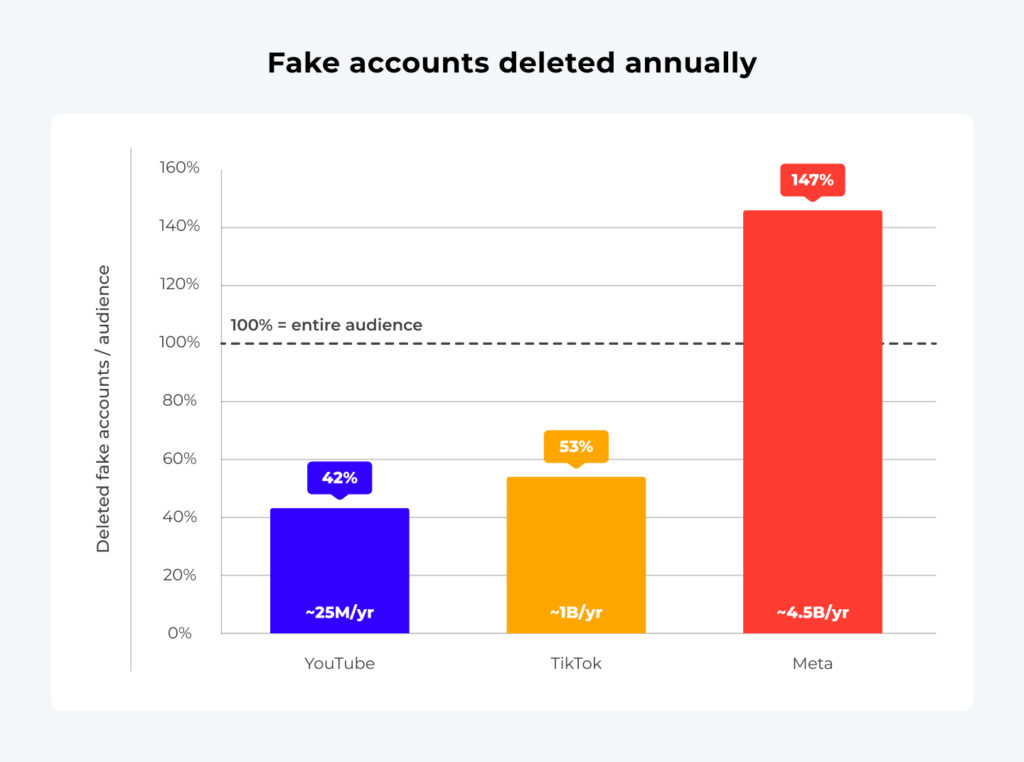
4. Fake accounts are a massive, mostly invisible problem
Meta removes roughly 4.5 billion fake accounts a year, which is 147% of its own reported audience size. TikTok removes about 1 billion (53% of its audience), and YouTube around 25 million spam channels (42%).
The report provides a comprehensive overview of the video traffic market, something that’s usually hard to find because the data is scattered across many sources. We’ve highlighted only the most striking trends, but the full research contains many more video statistics for your analysis.
Which GEOs Actually Pay Off
Using RichAds’ own platform data across the iGaming vertical, the research ranks the top 20 countries by impressions, CTR, and CPM. The most interesting part: the report goes a step further and calculates a CTR-to-CPM efficiency ratio to flag which markets are underpriced relative to how engaged their audiences actually are.
The Philippines tops the list by a wide margin, followed by India, Colombia, Thailand, and Indonesia. These are markets where engagement is clearly outrunning what advertiser competition has priced in so far. The research also flags Turkey as underpriced: a 4.6% CTR at a $0.45 CPM, while GEOs with similar CTR run CPMs 2–3x higher.
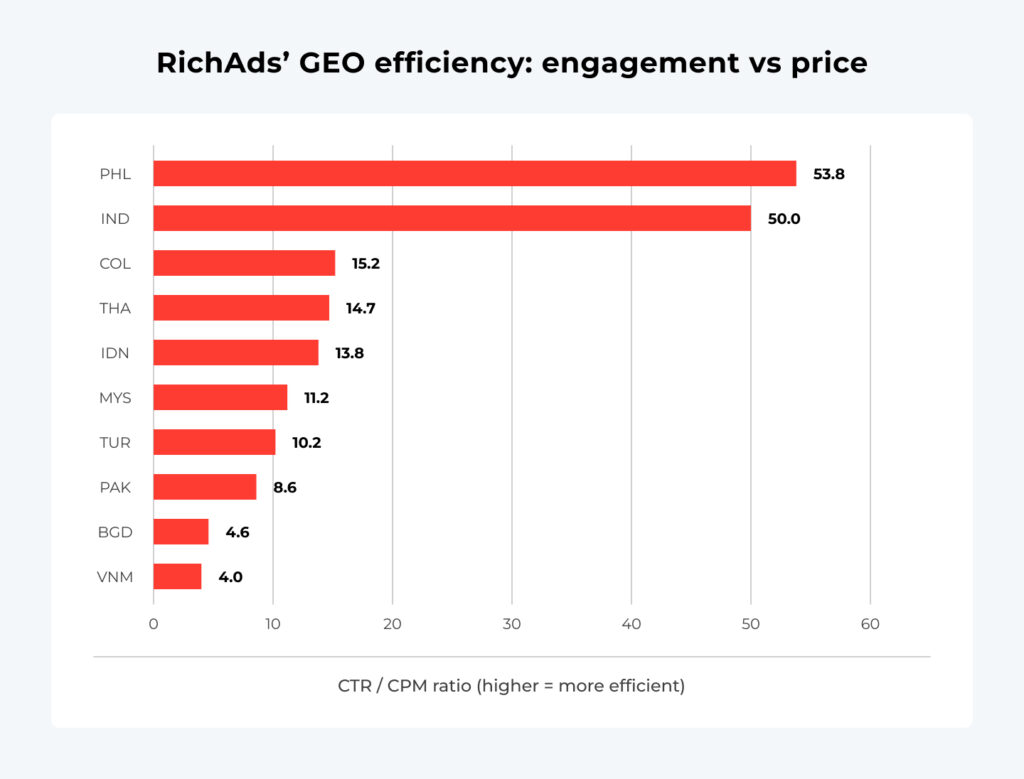
Source: RichAds platform data. RichAds is a trusted global advertising network for iGaming brands and agencies, built to scale the full funnel, from brand awareness to deposits.
This is highly valuable data for affiliates planning to run video traffic, as it highlights the top GEOs for market entry. Besides low-cost, high-volume countries, the report also includes recommendations for targeting Tier-1 countries, so you can pick GEOs to suit any affiliate strategy.
Note: the research itself recommends using India’s cheap volume for creative and lander A/B tests rather than as your main ROI source. Also keep in mind that India’s 2025 online gaming law restricts real-money gaming promotion. Check the current legal status before launching.
What RichAds offers to hit maximum KPIs on video
- Features: post-view tracking, automated rules, microbidding.
- User metrics: start, complete rate, skip, pause, mute, unmute, resume.
- Targeting: GEO/regions/cities, OS, device, impression cap, budget, bid, sources, schedule, language, carrier, ISP.
Proof in the Numbers: The Indonesia Pre-Roll Case Study
Statistics are good, but they’re more useful with real-world confirmation, and the research includes a real video campaign breakdown.
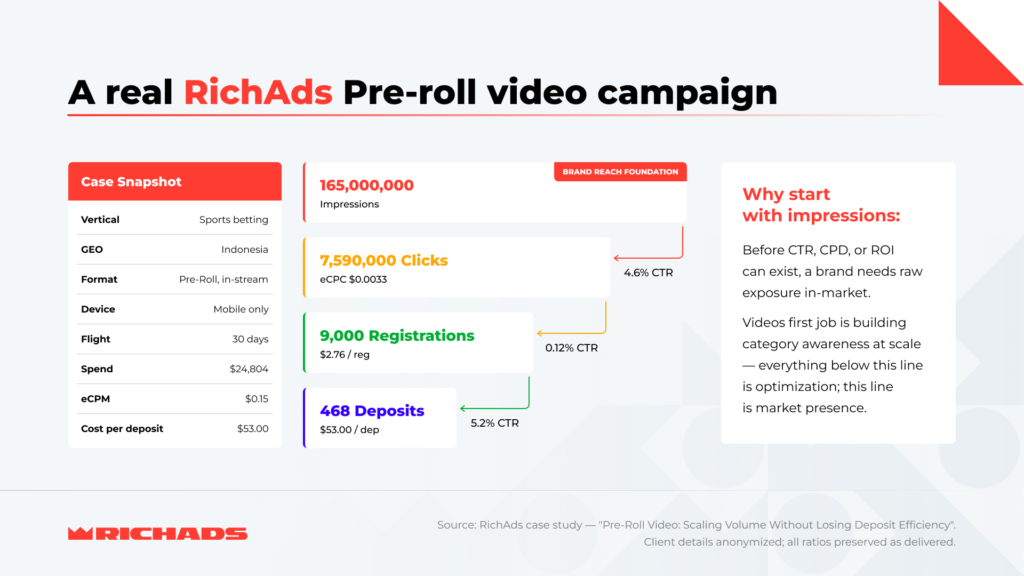
Lamish points to a RichAds case study on pre-roll video for a Betting brand in Indonesia. The brief was straightforward but hard to execute: grow reach aggressively while keeping cost per deposit predictable and low.
Campaign details
- Duration: 30 days
- Ad format: Pre-roll video (in-stream, skippable)
- Device: Mobile only
- Vertical: Betting
- GEO: Indonesia
- Total spend: $24,804
Results
- Impressions: 165,000,000+
- Clicks: 7,590,000 at a 4.6% CTR and $0.0033 eCPC
- Registrations: 9,000 at $2.76 per registration
- Deposits: 468 at a $53.00 cost per deposit (≈5.2% reg-to-dep conversion)
How the campaign was optimized
The setup combined:
- automated daily source blacklisting;
- whitelist accumulation for top-converting sources;
- micro-bidding at the individual-source level;
- isolated testing across 10 separate video creatives.
The team let the algorithm run broad first, then tightened spend as data came in.
As the research puts it, this case is “proof that pre-roll can scale volume aggressively without sacrificing quality in competitive verticals”. It also illustrates why RichAds frames video as a top-of-funnel reach tool rather than a direct-response format. Impressions build category awareness first; everything measured below that (CTR, CPD, ROI) is optimization on top of that foundation.
For affiliates used to working with push and pop ads, this campaign is great learning material, showing a completely different optimization approach.
Who Should Be Running Video Right Now
The research closes by segmenting the clients who get the most value from pre-roll video on RichAds:
- Operators entering new Tier-2/Tier-3 markets who need fast, cheap reach before pricing catches up.
- Media buyers testing creatives and hypotheses at scale, using high-volume, low-cost GEOs like India for rapid A/B testing.
- Established brands buying Tier-1 traffic, where lead quality matters more than raw CTR.
- Media buyers who want full-service support, from launch to creative production, directly from the RichAds team.
In short, video advertising is a top channel for anyone focused on business growth and monetization in 2026, which is exactly what makes this research so valuable.
Key Takeaway
The report’s core message: video advertising in 2026 isn’t one format. It’s an ecosystem of four fundamentally different buying sources, each with its own growth curve, moderation level, and pricing logic.
For Gambling and Betting media buyers, the choice of source should follow the specific job:
- Non-Mainstream networks for cheap, fast testing;
- Mainstream platforms for cleaner audiences;
- CTV for branding, with a license and budget to match.
RichAds’ pre-roll inventory sits squarely in the middle, offering whitelisted Mainstream access with anti-fraud filtering, S2S postback, Smart Retargeting, and Target CPA to close the gap between impression and deposit.
Check out the full video marketing research for the complete GEO tables, pricing benchmarks, and 2026 creative trends, including AI-generated creative detection. If you’re already producing video with AI, our Sora 2 affiliate guide is a good companion read.
Ready to test video traffic?