CPA Networks
 Ad Networks
 Affiliate Programs
 Offer base




Choosing between data management platforms in 2026 is harder than it looks, because the products behind the label have changed. Several of the best-known DMPs were retired between 2024 and 2026, and the vendors that remain now sell identity graphs, customer data platforms and warehouse-native stacks under the same name.
This guide compares 10 data management platforms that are actively developed today, with published pricing where vendors disclose it, the identity model behind each one, and a clear best-fit use case. AffRoom team also covers what changed in the market, so you can read older comparisons with the right context.
AffRoom is a catalogue of affiliate marketing companies and a unique networking platform for both companies and affiliates. Here you can find and connect with iGaming leaders, solo affiliates, advertising, affiliate and CPA networks in one place. It’s also a free offer base, as well as a transparent listing with blunt, honest reviews.
Find a full list of ad networks here at AffRoom!
What this guide covers:
- What a DMP is, how it works, and how it differs from a CDP and a CRM
- What changed in the DMP market between 2024 and 2026
- 10 platform profiles with pricing, identity model, pros and cons
- Shortlists by use case and a buyer’s checklist
- When a DMP pays back for performance teams — and when a tracker is enough
What Is a Data Management Platform (DMP)?
A data management platform is software that collects audience data from multiple sources, resolves it into unified profiles, groups those profiles into segments, and pushes those segments to advertising and marketing channels for targeting.
The classic definition was narrower: a DMP handled anonymous, cookie-based, third-party audience data for ad buying. Modern data management tools are broader and cover first-party data unification, identity resolution and privacy-safe data collaboration. That is why DMP, customer data platform and “data collaboration platform” now overlap so heavily in vendor marketing.
New to the terminology? The AffRoom glossary covers DMP, CDP, postback and attribution in one place.
How Data Management Platforms Work
Every platform in this list runs the same four stages, whatever it is branded:
- Ingestion. Pixels, SDKs, server-side events, CRM uploads and partner feeds push raw signals into the platform;
- Identity resolution and consent. The platform stitches signals into profiles — deterministically, by matching hashed emails and login IDs, or probabilistically, by inferring from device and behaviour — while applying consent flags so only permitted data is processed;
- Segmentation. Rule-based and machine learning models group profiles into audiences: high-intent buyers, lapsed customers, lookalikes;
- Activation and measurement. Segments push to DSPs, ad networks, email tools and on-site personalisation, and performance data flows back to refine the models.
Stage two is where the differentiation and most of the cost sit. The other three are close to commodity across vendors.
DMP vs CDP vs CRM: How a Data Management Platform, Customer Data Platform, and CRM Differ
| Dimension | DMP (classic) | Customer data platform (CDP) | CRM |
|---|---|---|---|
| Primary data | Anonymous, cookie-based, third-party | Identified, persistent first-party profiles | Transactional customer and prospect records |
| Identity model | Probabilistic, device-level | Deterministic, person-level | Named contact or account |
| Main user | Ad ops, programmatic buyers | Marketing, personalisation, CRM teams | Sales, customer success |
| Typical job | Audience targeting, lookalikes | Cross-channel journeys, real-time personalisation | Pipeline, account history, support tickets |
The short version: a DMP was built to reach strangers, a customer data platform is built to understand customers you already have. In 2026 most serious vendors sell the second thing, and the DMP vs CDP question is increasingly about which capabilities are switched on rather than which product you bought.

What Changed in the Data Management Platform Market Since 2024
Three shifts explain why a 2026 shortlist looks so different from a 2022 one. Knowing them saves you from evaluating a product that no longer exists.
Several flagship DMPs were retired. Salesforce acquired Krux for around $700 million in 2016, rebranded it Audience Studio, and set its end-of-life date at 1 February 2024. Oracle announced its exit from the advertising business on 11 June 2024, with BlueKai, Datalogix and ID Graph reaching end of life on 30 September 2024 after advertising revenue fell from a reported $2 billion in 2022 to roughly $300 million in fiscal 2024. Adobe has not published a retirement date for Audience Manager, but it markets Real-Time CDP almost exclusively and encourages existing Audience Manager customers to migrate.
Third-party cookies stayed in Chrome. This is the point most older buying guides still get wrong. On 22 April 2025, Google confirmed it would not deprecate third-party cookies in Chrome and would not ship the planned user-choice prompt. On 17 October 2025 it went further and announced the retirement of most Privacy Sandbox technologies, including Topics API, Protected Audience and Attribution Reporting, citing low industry adoption. Chrome began deprecating them in Chrome 144 in January 2026, with removal targeted for Chrome 150. The UK’s Competition and Markets Authority closed its Privacy Sandbox investigation in October 2025.
Cookies survive in Chrome, then, but they remain blocked by default in Safari and Firefox, users reject and delete them at high rates, and privacy regulation keeps expanding. The case for first-party data infrastructure was never really about Chrome.
Identity consolidated into one owner. Publicis Groupe agreed to acquire Lotame in March 2025, adding roughly 1.6 billion user profiles to its Epsilon stack. On 17 May 2026 it announced a deal for LiveRamp at $38.50 per share, around $2.5 billion in equity value and a 29.8% premium. LiveRamp shareholders approved on 17 August 2026; closing is expected before the end of 2026, subject to Hart-Scott-Rodino, CFIUS and non-US clearances.
For buyers this means vendor independence is no longer a durable feature of the identity layer. If neutrality matters to you, ask about ownership and governance commitments in writing.
How We Ranked These DMP Platforms
This is an editorial comparison rather than a benchmark. We did not run our own match-rate or latency tests, since those vary by geography, channel and partner, and a single number would mislead. Instead we cross-checked vendor pricing pages, product documentation, SEC filings and analyst coverage as of August 2026, and we flag cases where sources disagree.
| Criterion | Why it matters |
|---|---|
| Identity model | Deterministic vs probabilistic decides match rates and legal exposure |
| Data architecture | Copy-into-vendor vs warehouse-native changes cost, governance and lock-in |
| Activation reach | A segment you cannot push anywhere is a report, not an audience |
| Privacy and consent | Consent has to be captured at ingestion; retrofitting it is painful |
| Pricing transparency | Published rates vs “contact sales” changes how you budget |
| Ownership stability | Two major DMPs shut down inside 24 months, so roadmap risk is real |
One caveat on every figure below: enterprise data platforms rarely sell at list price. Treat published rates as an anchor for negotiation, not a quote.
Comparison Table: 10 Top DMP Platforms at a Glance
| # | Platform | Category | Identity model | Pricing (published) | Best for |
|---|---|---|---|---|---|
| 1 | Salesforce Data 360 | Packaged CDP | Deterministic, person-level | $500 / 100k credits, or $240–$420 per 1,000 profiles | Salesforce-stack enterprises |
| 2 | Adobe Real-Time CDP | Packaged CDP | Deterministic, person-level | Custom quote | Adobe Experience Cloud users |
| 3 | LiveRamp | Identity and data collaboration | Deterministic (RampID) | Custom, consumption-based | Cross-partner identity and clean rooms |
| 4 | Lotame Spherical | Audience data and identity | Deterministic and probabilistic | Custom quote | Audience extension and enrichment |
| 5 | Permutive | Publisher-side DMP and clean room | On-device cohorts | Custom; curation fees capped at 40% | Premium publishers and curation |
| 6 | Snowflake | Cloud warehouse with clean rooms | Bring your own | ~$2–4 per credit; ~$23/TB per month storage | Multi-cloud data sharing |
| 7 | Google BigQuery + Ads Data Hub | Warehouse and ad clean room | Bring your own | $6.25 per TiB scanned; 1 TiB/month free | Google Ads-centric advertisers |
| 8 | Databricks | Lakehouse | Bring your own | ~$0.07–$0.95 per DBU, plus cloud VMs | ML-heavy data teams |
| 9 | Hightouch | Composable CDP | Bring your own (warehouse) | Custom, tiered by destinations | Teams that already run a warehouse |
| 10 | Tealium | Independent CDP | Deterministic and probabilistic | Custom, priced on events collected | Vendor-neutral mid-market and enterprise |
The 10 Best Data Management Platforms in 2026, Reviewed
1. Salesforce Data 360
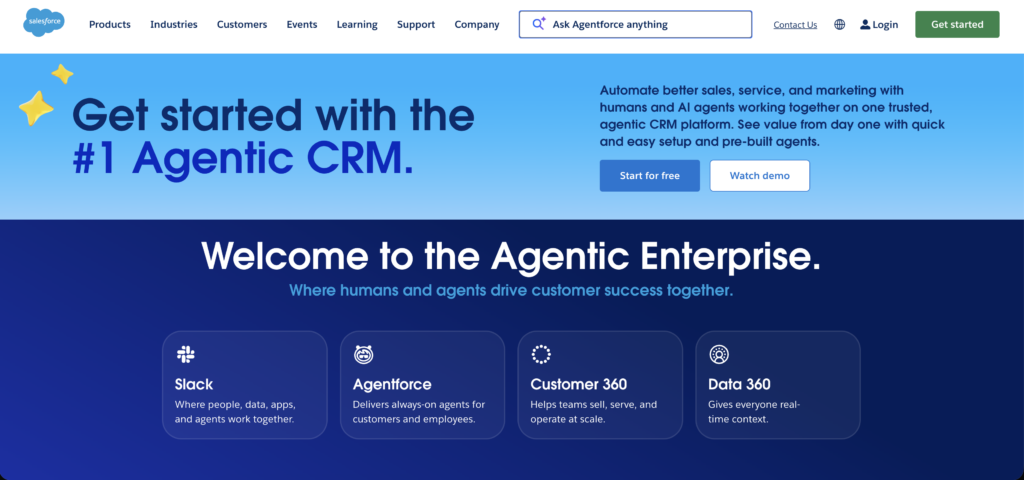
Formerly Salesforce Data Cloud — the product was renamed Data 360 in October 2025 and repositioned from a customer data platform to an enterprise-wide data foundation. It unifies profiles across Salesforce clouds, resolves identity at person level, supports zero-copy federation with Snowflake, BigQuery, Databricks and Redshift, and activates segments directly into Marketing, Sales and Service Cloud.
Salesforce overhauled pricing effective 2 March 2026 with three models: consumption credits at a list price of $500 per 100,000 credits, flat profile-based pricing at $240–$420 per 1,000 profiles, and fungible Flex Credits shared across Data 360, Agentforce and Slack. Storage runs $23 per TB per month, the Data 360 Starter SKU lists at $60,000 per year, and existing Salesforce customers can provision a free tier limited to around 10,000 unified profiles.
Watch identity resolution specifically: at 100,000 credits per million rows it is roughly 50 times the cost of external data ingestion and can dominate the bill. One source cites $1,000 per 100,000 credits rather than $500, so confirm the current rate with your account team.
Best for: enterprises already running two or more Salesforce clouds.
Pros: deepest activation ecosystem inside Salesforce, mature governance, strong AI tooling, zero-copy federation with major warehouses.
Cons: value drops sharply outside the Salesforce estate, credit consumption is hard to forecast, identity resolution costs escalate quickly.
2. Adobe Real-Time CDP
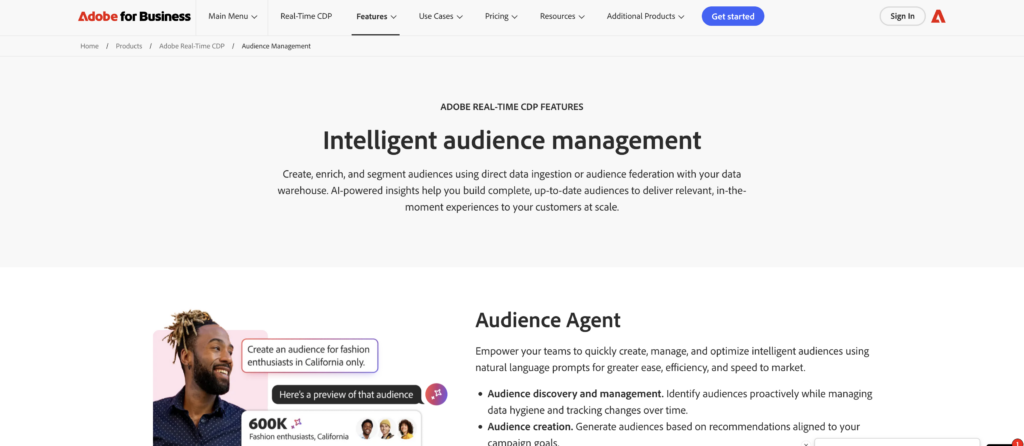
Adobe’s answer to the DMP question, built on Adobe Experience Platform. It assembles person-level profiles from Analytics, Target and Experience Manager data and activates them into Adobe Advertising, Campaign and third-party destinations. Legacy Audience Manager still runs but receives minimal investment, so it should not be evaluated for a new build.
Two housekeeping items from Adobe’s 2026 release notes: Segment Match is being discontinued after 27 November 2026, with data collaboration use cases moving to Real-Time CDP Collaboration. Adobe does not publish pricing, so expect a custom enterprise quote. In the January 2026 Gartner Magic Quadrant for Customer Data Platforms, Adobe was placed in the Visionaries quadrant.
Best for: organisations already running Adobe Analytics and Experience Manager in production.
Pros: native integration removes most multi-vendor implementation friction, strong governance controls, real-time profile updates for time-sensitive personalisation.
Cons: no published pricing, value tightly coupled to the Adobe stack, Audience Manager migration is a project in its own right.
3. LiveRamp
The connective layer of the modern marketing data stack. RampID is a pseudonymous, people-based identifier that links identities across devices, channels and partners without third-party cookies. The network spans 21,000+ publisher domains, 200+ ad-tech platforms and most major streaming and retail media networks.
Fiscal 2026, ended 31 March 2026, brought $813 million in revenue, up 9%, with annual recurring revenue of $545 million, 846 direct subscription customers and 133 of them spending over $1 million a year. IDC named LiveRamp a Leader in data clean room technology for advertising in 2025.
The open question is ownership. The pending Publicis acquisition places a neutral infrastructure layer inside an agency holding company that competes with many of its customers. Publicis has committed to running LiveRamp as an independent business in its Technology segment, with Scott Howe staying on as CEO.
Best for: brands and publishers that need identity resolution and clean-room collaboration with partners they do not own.
Pros: unmatched partner network, cookieless-native identity, zero-copy collaboration across AWS, Azure, GCP, Snowflake and Databricks.
Cons: no published pricing and an enterprise-only sales motion, plus an open neutrality question until the deal closes.
4. Lotame Spherical
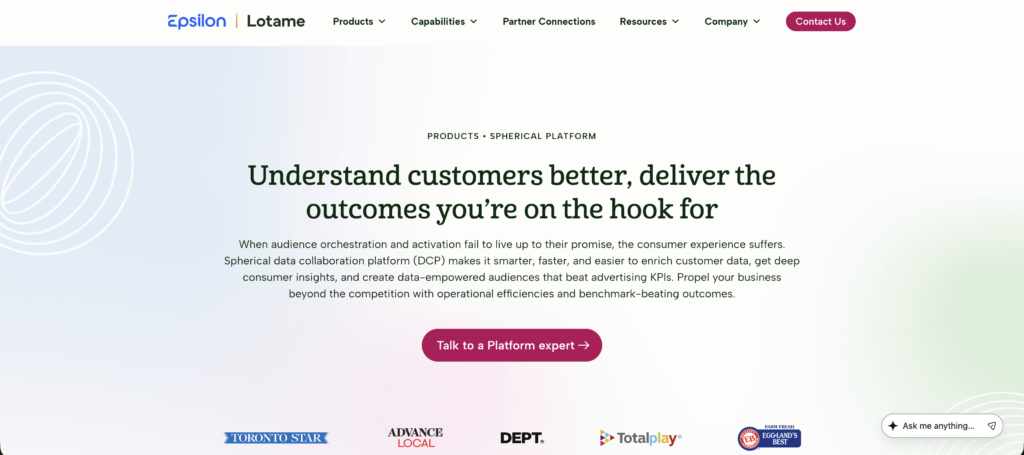
Founded in Maryland in 2006, Lotame launched one of the first DMPs in the category in 2011 and has since repositioned around Spherical, its data collaboration platform, and Panorama ID, its cookieless identifier. Panorama ID has been adopted by 18,000+ publishers and is authorised inside Google’s SSP.
Worth correcting if you are reading older comparisons: Lotame is no longer independent. Publicis agreed to acquire it in March 2025 and folded its audience graph into Epsilon.
Best for: advertisers and agencies that need audience extension, enrichment and second- or third-party data access without building it themselves.
Pros: mature global data marketplace across 100+ countries, faster time-to-value than assembling a composable stack, strong enrichment tooling.
Cons: now agency-owned, which may matter to Publicis competitors, custom pricing only, long-term value depends on Panorama ID adoption holding up.
5. Permutive
A London platform founded in 2013, with around $116 million raised and roughly 108 employees. Its differentiator is on-device processing: segmentation happens in the browser rather than on a server, which lets publishers build audiences from logged-out and consented traffic without third-party cookies.
Permutive now describes itself as a data collaboration and activation platform, combining a clean room spanning 150+ open-web publishers, curation, and first-party data activation. Its curation product packages publisher cohorts into SSP marketplaces including Index Exchange, PubMatic and Google Curated Deals, with fee structures documented as capped at 40%. In July 2026 it announced a partnership with Adform for identity-flexible activation.
Best for: premium publishers monetising cookieless inventory, and advertisers buying curated publisher audiences.
Pros: purpose-built for signal loss, strong reputation among premium publishers, transparent curation fee cap.
Cons: publisher-first, so advertiser-side use cases are narrower, activation breadth depends on publisher demand integrations, no public pricing.
6. Snowflake
Not a DMP on its own, which is precisely the point. Snowflake is the cloud data platform underneath a growing share of composable stacks, and its Data Clean Rooms allow audience collaboration with retail media and publisher partners without exposing raw records. Snowpark handles Python and Java workloads, Cortex covers AI and ML functions, and the Marketplace offers hundreds of third-party datasets.
Pricing is credit-based, typically $2–$4 per credit depending on edition and region, with storage around $23 per TB per month. Warehouse sizes scale from XS at 1 credit per hour to 6XL at 512.
Best for: data-mature teams that treat multi-cloud portability and partner collaboration as strategic capabilities.
Pros: best-in-class data sharing and clean rooms, per-second billing, runs on all three major clouds, large activation partner ecosystem.
Cons: consumption costs escalate without query governance, you will need a composable CDP or reverse-ETL layer on top to make it a working DMP, and the 60-second minimum on warehouse resume makes small frequent queries expensive.
7. Google Cloud BigQuery + Ads Data Hub
BigQuery is a serverless warehouse with no clusters to size; Ads Data Hub is the privacy-safe environment for analysing Google Ads and YouTube event-level data. Together they are the strongest option for advertisers whose spend concentrates in the Google ecosystem, particularly where GA4 already serves as the behavioural source of truth.
On-demand pricing is $6.25 per TiB scanned, with the first 1 TiB each month free. Capacity pricing under Editions runs $0.04–$0.10 per slot-hour depending on tier and commitment, and storage is $0.02 per GB per month active, $0.01 long-term. The model rewards well-partitioned tables and punishes exploration: a single unfiltered scan of a 10 TiB table costs $62.50.
Best for: Google Ads-heavy advertisers, ecommerce teams, and organisations standardising analytics on Google Cloud.
Pros: cheapest realistic entry point among major warehouses, zero infrastructure management, native BigQuery ML and Vertex AI, deep GA4 and DV360 integration.
Cons: per-scan billing punishes ad-hoc work, activation outside Google needs extra tooling, clean-room aggregation thresholds limit small-segment analysis.
8. Databricks
The lakehouse option, and the right answer when audience modelling is genuinely custom rather than a packaged feature. Unity Catalog handles governance and lineage across data and AI assets, MLflow and Mosaic AI cover the model lifecycle, and Delta Sharing enables open cross-platform exchange without vendor lock-in.
Pricing is per DBU consumed on top of cloud VM spend — roughly $0.07–$0.13 per DBU for Jobs Compute and $0.15–$0.55 for All-Purpose, with premium SKUs higher. Budget for the infrastructure underneath, since the VM bill typically adds substantially to the DBU line.
Best for: teams where propensity scoring, recommendation engines and custom segmentation models are core competencies.
Pros: industry-leading ML tooling, open Delta Lake format that limits lock-in, strong governance through Unity Catalog.
Cons: requires real data engineering maturity, ships no marketer-friendly segmentation UI, DBU spend is unpredictable when jobs are untuned.
9. Hightouch
The composable CDP that made warehouse-native architecture mainstream. Rather than copying data into a vendor system, Hightouch reads directly from Snowflake, BigQuery, Databricks or Redshift and syncs audiences out to ad platforms, email tools and CRMs. No duplicate storage, unlimited lookback, and your existing governance applies.
It was named a Leader in the Gartner Magic Quadrant for Customer Data Platforms for the first time in January 2026. That placement reflects a wider shift: per the CDP Institute’s January 2026 industry update, composable and warehouse-native vendors recorded 7.8% organic employment growth against an industry average of 1.3%, and more than a quarter of CDPs now support warehouse-centric architecture.
Best for: teams that already run a warehouse and want marketer-friendly activation on top of it.
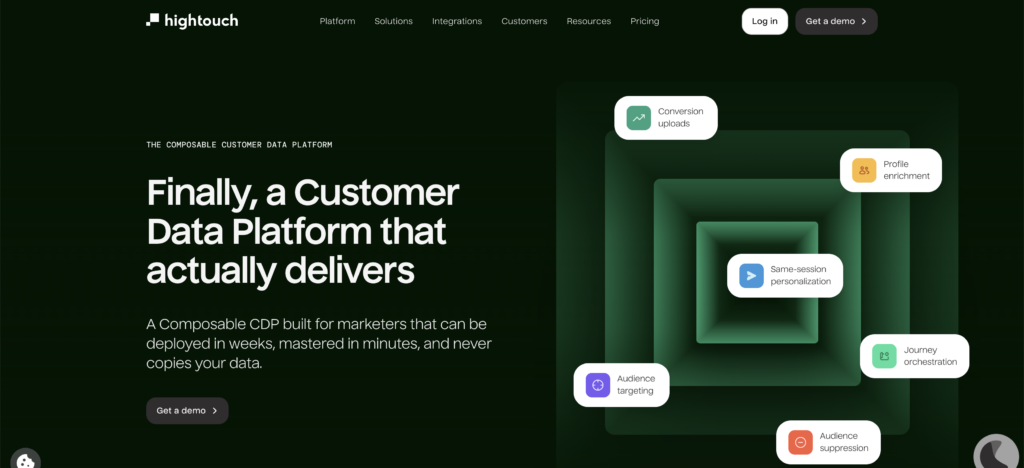
Pros: no data duplication or MTU-based billing, fast deployment because data never migrates, strong destination coverage.
Cons: assumes an existing warehouse and downstream execution tools, fewer destinations than Segment, quote-based pricing.
10. Tealium
One of the few genuinely independent CDPs still operating at scale. The Tealium Customer Data Hub combines tag management, server-side event routing and profile unification with 1,300+ pre-built connectors, the widest integration library in the category. AudienceStream’s visitor stitching builds profiles in real time and pushes audiences to existing marketing tools.
Pricing is quote-based and calculated on events collected, with service hours bundled by volume tier. Worth noting honestly: Tealium dropped from Leader to Challenger in the January 2026 Gartner Magic Quadrant as the category tilted toward warehouse-native architectures.
Best for: mid-market and enterprise teams that want a platform not owned by Salesforce, Adobe, Google or an agency group.
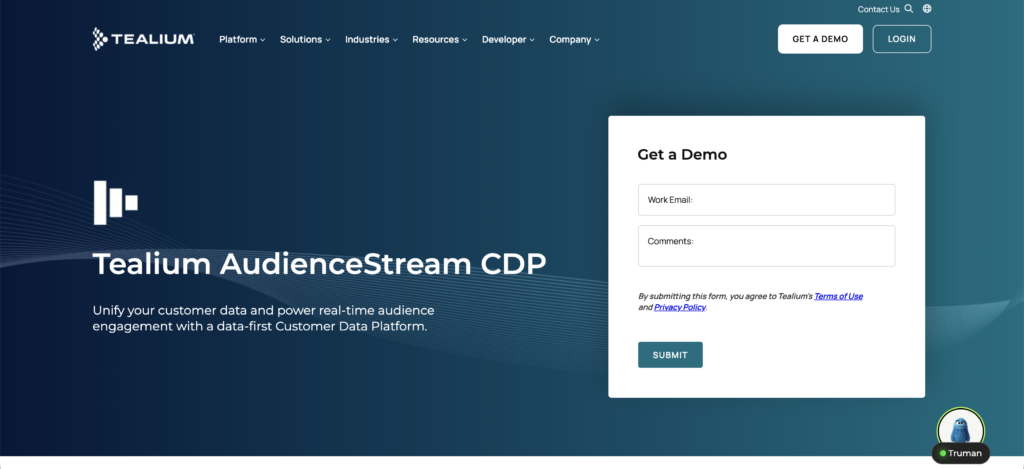
Pros: vendor independence, unmatched connector library, strong compliance posture, mature real-time capability.
Cons: event-based pricing scales awkwardly for high-traffic low-value sessions, analyst momentum has moved toward composable rivals, no published rates.
The Leading Data Management Platforms for Data Governance in 2026
Everything above assumes “data management platform” in its marketing sense: identity, activation, audience data. IT and data teams often mean something different when they type the same search — a governance platform for cataloguing, data quality and lineage across an entire company.
If that is your use case, the shortlist looks nothing like Salesforce Marketing or Adobe. It centres on a data catalog, metadata management and master data management rather than pixels and identity graphs, and it is usually bought by a chief data officer rather than a growth team. Enterprise data management of this kind solves a real problem — trusted data downstream — but it is a different budget line and a different buyer.
Data Governance Platforms: Informatica, Collibra and SAP
Informatica brands its flagship suite the Intelligent Data Management Cloud (IDMC), combining an AI-powered data quality platform, data masking for sensitive fields, and lineage that traces a value back to its source system, all driven by its CLAIRE AI engine.
One important ownership note that most comparisons have not caught up with: Informatica is no longer independent. Salesforce completed its acquisition for approximately $8 billion on 18 November 2025, and the product now goes to market as Informatica from Salesforce, with its catalog, governance and MDM services being folded into the Agentforce 360 platform. Headless IDMC, which exposes those capabilities as services to AI agents on AWS, Azure, Databricks and Snowflake, is in private preview with general availability planned for summer 2026. If you are evaluating Informatica specifically to avoid Salesforce lock-in, that logic no longer holds.
Collibra competes on similar ground and remains independent, with workflow-driven governance and a searchable data catalog built for business stewards rather than engineers.
SAP covers the same territory for organisations standardised on SAP, though its product line has moved. SAP Data Intelligence Cloud is winding down — no new subscriptions are being sold, with mainstream maintenance ending 31 December 2028 — and the strategic successor is SAP Datasphere, now delivered as part of SAP Business Data Cloud. Check which product a proposal actually names before signing.
None of these three plugs into an ad exchange, and none should. They exist for data management across finance, HR and product data, not marketing activation.
Cloud Data Platforms: Warehouses First, DMPs Second
Snowflake, BigQuery and Databricks are cloud data platforms first and DMPs second — you get a warehouse or lakehouse, then build identity resolution on top rather than getting it out of the box. That trade-off is exactly why data-mature teams pick them. A serverless data warehouse handles structured tables and unstructured data without separate systems, and a modern data stack built this way scales cleanly as volumes grow.
Databricks adds automated data discovery and governance across data lakes plus native support for data science workflows, so machine learning teams are not exporting data to a separate analytics platform to train models. Snowflake and BigQuery focus more narrowly on warehousing and data pipelines. For pure data intelligence — understanding what you have before trying to activate it — this cloud-native layer is what most 2026 analytics infrastructure is actually built on, whether or not it carries the DMP label.
Data Integration: When the Real Gap Is Plumbing
Sometimes the problem is not identity or governance but pipelines: getting data out of a wide range of sources and into a warehouse without an engineering team hand-rolling scripts for each one. That is a data integration problem, and it is solved by a data integration platform — Fivetran, Airbyte and Hightouch’s own sync layer are the common choices. These handle managed pipelines, schema drift and monitoring, so nobody is maintaining custom connectors for every tool in the stack.
The right choice depends on data strategy as much as architecture. Teams still fighting data silos usually need reliable integration and clearer ownership before another activation layer will help. This is unglamorous data operations work, but it is what keeps everything else in this guide fed with clean data.
Why Lineage Still Matters
None of this matters if nobody trusts the numbers. Trusted data means every field can be traced through lineage back to its source, each stage of the data lifecycle has an owner, and changes are logged rather than silent. That is the promise of end-to-end data management: one governance layer covering ingestion through archival, instead of quality checks bolted onto the end of a pipeline.
For most teams the practical version is simpler — manage quality and lineage for the handful of data assets that actually drive decisions, and do not try to boil the ocean on day one.
Best Data Management Platform by Use Case
- Already on Salesforce or Adobe. Salesforce Data 360 or Adobe Real-Time CDP. Integration savings usually outweigh the licence premium, but only when two or more products in that suite are already in production;
- Cross-partner identity and clean rooms. LiveRamp, with Snowflake as the substrate. Build the neutrality question into the contract given the pending Publicis deal;
- Audience extension and enrichment. Lotame Spherical for marketplace reach, LiveRamp for match rates against your own first-party file;
- Publisher monetisation without cookies. Permutive. On-device cohorts plus curation is the most mature route to monetising logged-out inventory;
- You already have a warehouse. Hightouch on top of Snowflake, BigQuery or Databricks — the cheapest realistic path to a working stack, with no data leaving your control;
- Google Ads-centric measurement. BigQuery plus Ads Data Hub, the only production environment for event-level YouTube and Google Ads analysis;
- Custom modelling as the differentiator. Databricks, paired with a separate activation layer;
- Vendor neutrality above all. Tealium, or Collibra if the requirement is governance rather than activation.
When a DMP Pays Back for Performance Teams
Data management platforms are built around retention economics: unifying identified customer records across owned channels to raise lifetime value. Affiliate and media buying operations are acquisition businesses, so the threshold for adopting one is specific rather than general.
A DMP starts to pay back when three things are true at once: you own a meaningful first-party data asset, you have repeat-purchase economics worth modelling, and the same user is reachable across three or more channels you control. Until then, the same jobs are covered more cheaply by tracking infrastructure.
For most media buyers the working stack looks like this:
- Conversion tracking. An affiliate tracker handles click and conversion logging, sub-ID reporting and offer routing at a fraction of the cost;
- Correct attribution. Postback-based server-to-server tracking removes the browser dependency that the cookie debate is really about;
- Metrics you act on. Segmentation is worthless without a measurement framework — start with the core affiliate marketing KPIs rather than building audiences you cannot evaluate;
- Traffic sources matched to verticals. Whether that is CPC ad networks or cheap push traffic, audience quality at the source beats audience modelling downstream;
- Diversified offers. CPA, RevShare and hybrid payouts across several affiliate networks;
- An analytics warehouse when volume justifies it. BigQuery or Snowflake is the natural first step toward a composable stack, and it is reversible.
AffRoom maintains vetted directories of CPA networks, ad networks and current affiliate offers for teams building that layer first.
Buyer’s Checklist: Choosing a DMP in 2026
- Define three use cases before looking at vendors. Suppression, lookalike modelling, clean-room measurement — pick the specific jobs and let them drive selection, because demos are designed to expand scope;
- Interrogate the identity model. Deterministic or probabilistic, and what match rate against your own file in your geographies? Ask for a test rather than a case study;
- Model three years of cost. Include consumption growth, professional services, internal headcount and training. Consumption pricing that looks cheap in a pilot behaves differently at production volume;
- Check ownership and roadmap risk. Ask what happens to your data and contracts under acquisition, and get the answer in writing;
- Capture consent at ingestion. Retrofitting consent rules onto historical audience data is operationally painful and legally exposed, with around 20 US states now operating comprehensive privacy laws alongside GDPR;
- Pilot on one channel. Prove segment-to-revenue impact on a single activation channel before expanding, since most failed deployments over-bought capability nobody used.
FAQ
What are data management platforms?
A data management platform collects audience data from first-, second- and third-party sources, resolves it into unified profiles, groups those profiles into segments, and activates those segments across advertising and marketing channels. Classic DMPs handled anonymous cookie-based data for ad targeting, while modern data management tools focus on first-party data, deterministic identity and privacy-safe collaboration.
What is the difference between DMP and CDP?
A DMP traditionally worked with anonymous, cookie-based, third-party audience data at device level for advertising reach. A customer data platform works with identified, persistent first-party profiles at person level for cross-channel personalisation and retention. In 2026 the categories have largely merged, since Salesforce, Adobe and Oracle all retired or deprioritised their DMPs in favour of CDPs, so most products sold as DMP platforms today are CDPs, warehouses with clean rooms, or identity graphs.
Which are the best data management platforms in 2026?
It depends on your existing stack. Salesforce Data 360 and Adobe Real-Time CDP lead for enterprises already inside those ecosystems. LiveRamp is the strongest identity and clean-room layer for cross-partner work. Snowflake, BigQuery and Databricks anchor warehouse-native stacks, usually paired with Hightouch for activation. Lotame and Permutive serve audience extension and publisher monetisation respectively, and Tealium is the leading independent option. Match the identity model and architecture to your data maturity first.
How do data management platforms work?
In four stages. Ingestion pulls signals from pixels, SDKs, server-side events, CRM uploads and partner feeds. Identity resolution stitches those signals into profiles through deterministic matching or probabilistic inference, applying consent flags along the way. Segmentation groups profiles into audiences using rules or machine learning. Activation pushes those segments to DSPs, ad networks, email platforms and on-site personalisation, with performance data flowing back to refine the models.
What features should a good data management platform have?
Five things matter most: a documented identity model with match rates you can test against your own data, consent management applied at ingestion rather than activation, pre-built integrations with the ad, CRM and analytics tools you already run, transparent pricing you can model three years forward, and native AI or ML for lookalike modelling and predictive scoring so you are not paying for a second platform. Ownership stability belongs on the list too, given how much the category consolidated between 2024 and 2026.
Final Thoughts
The best data management platforms in 2026 split into three groups. Packaged CDPs from Salesforce and Adobe win where their ecosystems are already deployed. Warehouse-native stacks — Snowflake, BigQuery or Databricks with a composable layer such as Hightouch on top — win where engineering capacity exists, and that is where the category’s growth is concentrated. Identity and collaboration specialists like LiveRamp, Lotame and Permutive connect parties that will never share raw data.
Match the platform to your identity strategy and data maturity rather than to the longest feature list, model three years of cost before signing, and confirm the product you are evaluating is still on the vendor’s roadmap. For performance teams, the practical sequence is tracking and traffic first, then a warehouse, then a full data platform once first-party volume justifies it.