CPA Networks

 Ad Networks

 Affiliate Programs

 Offer base





Game providers pay a lot for player acquisition, but they see the results late. Standard analytics shows FTDs and deposits, and that is about it. What a specific player does inside a slot stays hidden. Media buyers have the mirror problem: they need to prove their traffic is made of real players, not just registrations.
In this case study, the provider Bubble Gaming, the media buying team dep.monster and the analytics platform Playerly put the two sides on the same page. In one month, affiliates delivered 5,000+ FTDs to an operator. 1,015 of those players opened Bubble Gaming slots and made 460,700 spins.
Below: how the campaign was set up, which funnels worked, which ones flopped, and why a buyer should care about what happens after the click.
This case study was prepared by the AffRoom team based on data from Playerly, dep.monster and Bubble Gaming. We follow how affiliates and iGaming brands work together, and direct deals with providers are one of the most practical ways to add revenue.

The Campaign in Numbers
| Parameter | Value |
|---|---|
| Period | July 1-31, 2026 |
| Game provider | Bubble Gaming |
| Media buying team | dep.monster (17 media buyers plus tech, creative and account-farming departments) |
| Analytics platform | Playerly |
| GEO | Tier-1 / Tier-2 Europe |
| Traffic sources | Meta Ads, SlotCatalog (SEO traffic) |
| Affiliate payout | $140 per FTD |
| Additional provider payout | $20 per player who made spins in Bubble Gaming titles |
Results
| Metric | Value |
|---|---|
| Ad spend | up to $500,000 |
| FTDs | 5,000+ |
| Players who opened Bubble Gaming slots | 1,015 (20.3% of all FTDs) |
| Spins in Bubble Gaming titles | 460,700 |
| Extra income from the provider | $20,300 (20 × 1,015 players) |
| Total revenue | $700,000+ |
| ROI | 45%, about 5 points above the usual figure for this GEO. The team credits the direct deal with the provider |

Why the Provider and the Buyers Needed Each Other
The provider wants a steady flow of targeted players into its slots. To get there, it integrates with aggregators and operators, who share some stats and hand out promo codes. But even with operator data, the provider cannot really tell how many players reached its games, or how they played. Someone has to dig into this and optimize it, which is expensive and slow.
The buyer’s problem is different. Ads keep getting pricier, margins keep shrinking, and advertisers do not rush to raise CPA. So buyers look for extra revenue streams, and working with providers directly is one of them.
To give both sides the same picture, they connected Playerly. It tracks the whole player journey: from the first click on a creative to what actually happens in a slot, including which game the player opened, how many bets they made and for how much, how long the session lasted, and so on.
- For the provider: cross-platform analytics across casinos. You see which operator a player came from and how they played. There is also a pool of media buyers connected to the platform, so a provider can find partners for direct deals.
- For the affiliate: a direct line to providers who are ready to pay extra for players brought to their slots. Same spend, two payouts: a fixed CPA from the operator and a bonus from the provider. Buyers can also optimize campaigns for in-game events like slot open, first spin or bonus buy, not just for deposits.
Looking for traffic sources and partners? Compare options in our ad networks catalog and browse casino affiliate programs.
The Deal
Bubble Gaming picked dep.monster from the buyers connected to Playerly. Both sides agreed on the GEO, timeline, game, ad platforms and the criteria for judging success.
dep.monster was already sending traffic to one operator at $140 CPA. The provider added +$20 for every player who spun its slots at that same casino. The logic is simple: the affiliate gets another revenue stream, and the provider pays for a measurable action inside its game rather than for a click.
Both teams watched the same dashboards in Playerly, so there were no arguments about whose numbers were right.
Choosing the Slot to Promote
Picking the wrong game at the start can sink a campaign, so Bubble Gaming did not guess. It looked at three things:
- Availability at operators. SlotCatalog shows which casinos carry the game and where it sits in the lobby.
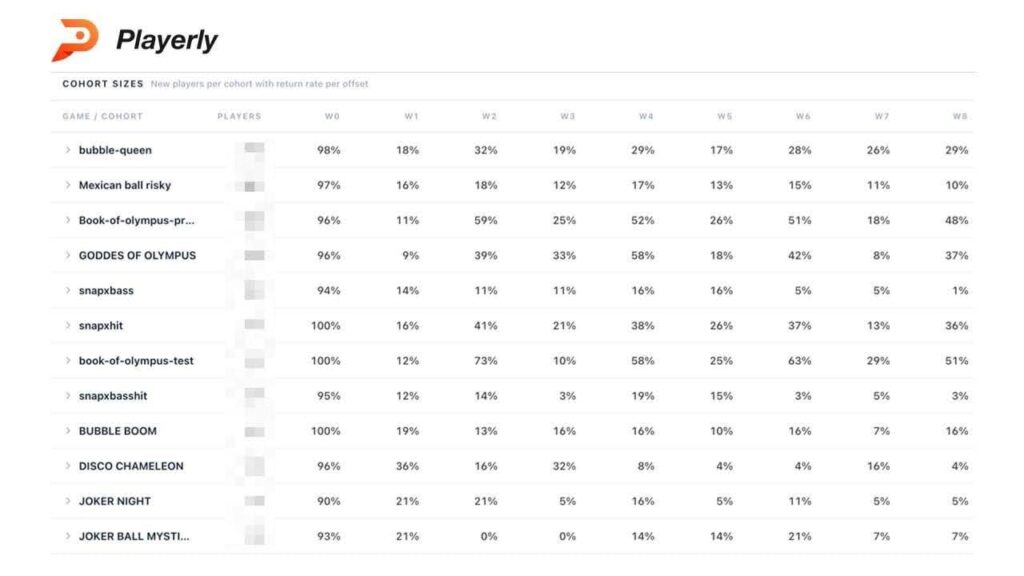
- Retention. How well the slot holds players.
- Average session length. Data from Playerly.
Several titles passed the test. The most popular were Bubble Queen (the best return rate), Mexican Ball Risky and Book of Olympus Pride. A bonus: the names and themes are easy to associate with other well-known games.
Mythology was a deliberate bet, too. According to SlotCatalog, Egyptian, Greek and Norse slots make up almost 3,400 games, around 7% of the market. The Greek theme, where Book of Olympus Pride belongs, grew 17% between 2023 and 2025, and April 2026 brought a record 65 mythology releases in a single month. Players know and love the genre. The flip side is heavy competition for any new title in it.
Funnels: What Failed and What Worked
For the first test, the buyers tried three approaches:
- showing the character and the game mechanics;
- an animation of a big win with a 4,000x multiplier;
- a live player reaction to a win.
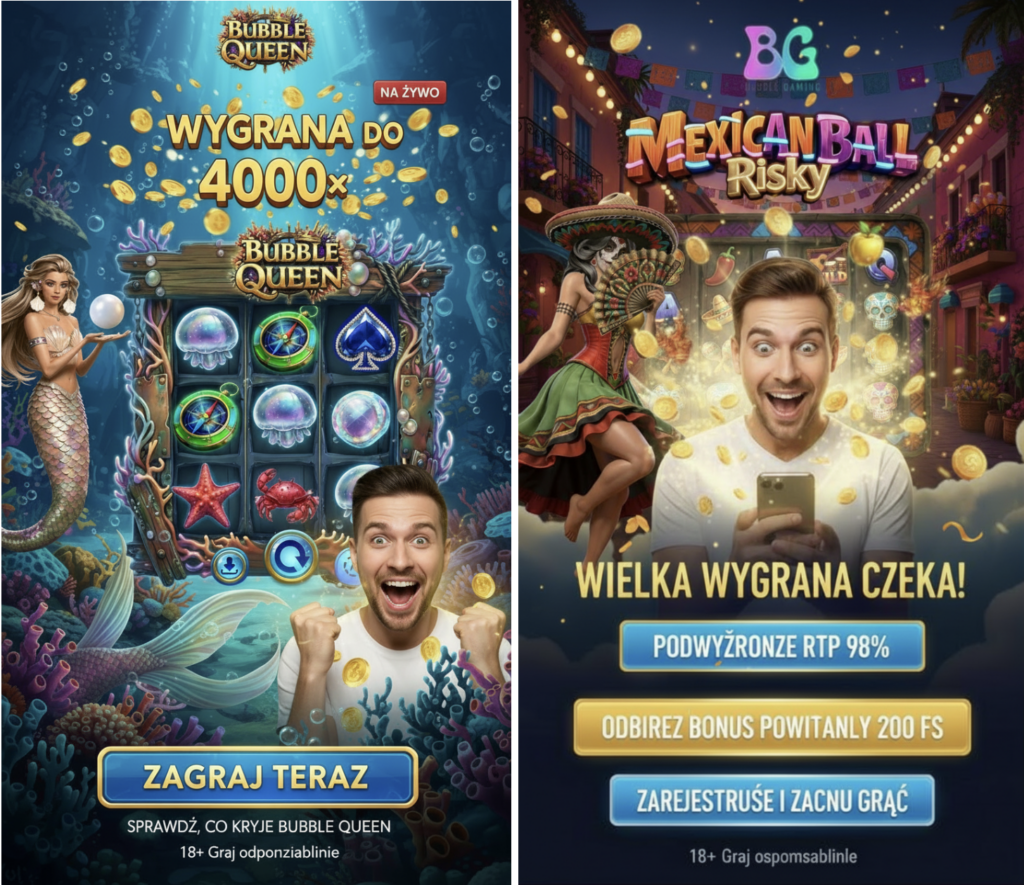
None of them turned a profit. The character creative got clicks and click-throughs, but few people went on to launch the game. The creative with a detailed look at the mechanics got banned more often than the rest. The best performer was the mix of win animation, 4,000x multiplier and live reaction, since it brought in more users who opened the right Bubble Gaming titles. Still, it was not the result anyone hoped for.
Then the team figured out what was going on. Bubble Gaming simply is not a well-known brand. The casino got its FTDs, but players were not finding their way to the provider’s slots.
FOMO Instead of the Brand
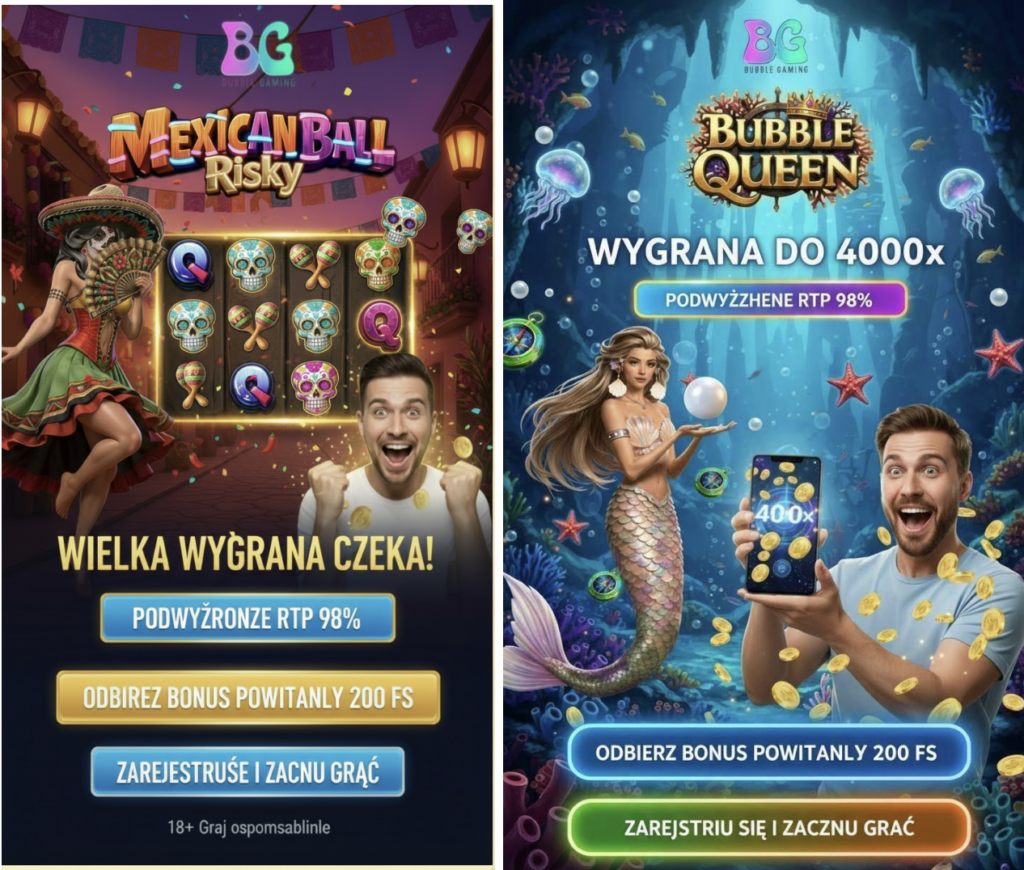
So the next funnel played on FOMO. The creatives said a new high-RTP game was taking the market by storm and that people playing it right now were winning. This one worked: results became stable and predictable.
References to Well-Known Games
Another of the most profitable funnels leaned on creatives that referenced big-name games, elements of which appear in Book of Olympus Pride and Bubble Queen. The message was along the lines of: everyone has dropped the outdated games and moved on to winning on new Bubble Gaming slots.

SEO Traffic from SlotCatalog
Part of the traffic did not come from Meta Ads at all. It came from organic search on SlotCatalog.com, and this is a different kind of player. They look for a particular slot on their own, read the review, check RTP and volatility, try the demo, and only then go to a casino. SlotCatalog ranks first in search for slot names and demos in key markets, including the UK: across six verified markets, that is 382,500 and 331,600 searches a month respectively. These people come for the game, not for the creative. <!– VERIFY: search volumes and the “ranks first” claim come from SlotCatalog; ask the partner what “respectively” refers to (slot names and demos). –>
For more on how search works for this vertical, see our guide to casino SEO. To see how creatives for the vertical look in practice, check the iGaming ads examples.
Where Playerly Made the Difference
Without it, optimization would have leaned mostly on Meta Ads data and FTD counts. Playerly added what happens after the deposit: who launched the slot, who came back to it, and how long they stayed. That let the buyers judge creatives and funnels by the quality of the players they brought in, not just by the number of clicks and registrations.
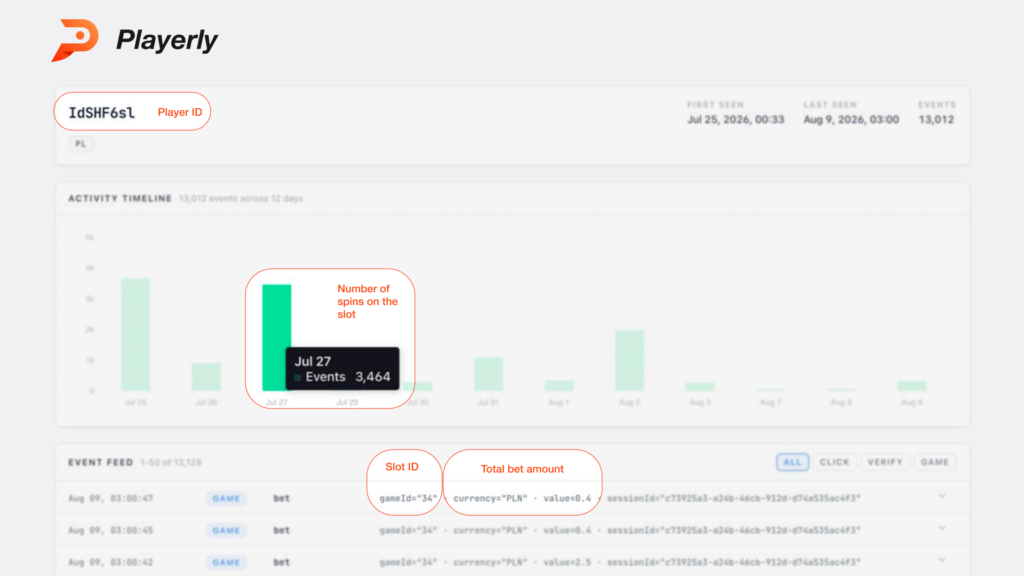
The player list shows the same picture in total: for the selected period, this player made 8,893 spins.

In one month, the affiliates brought the operator more than 5,000 FTDs. Of these, 1,015 players (20.3%) opened Bubble Gaming titles at least once.
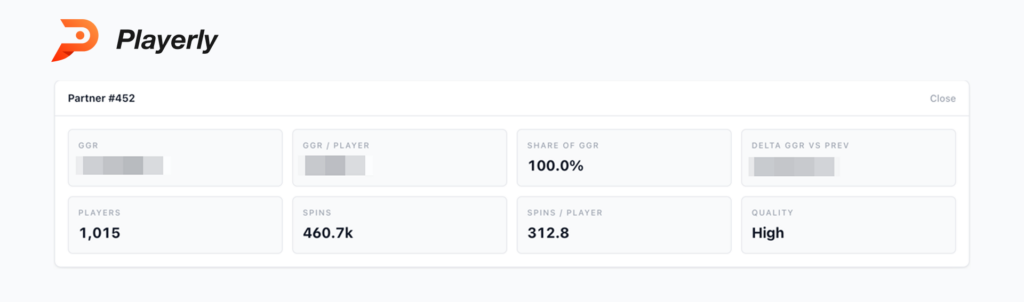
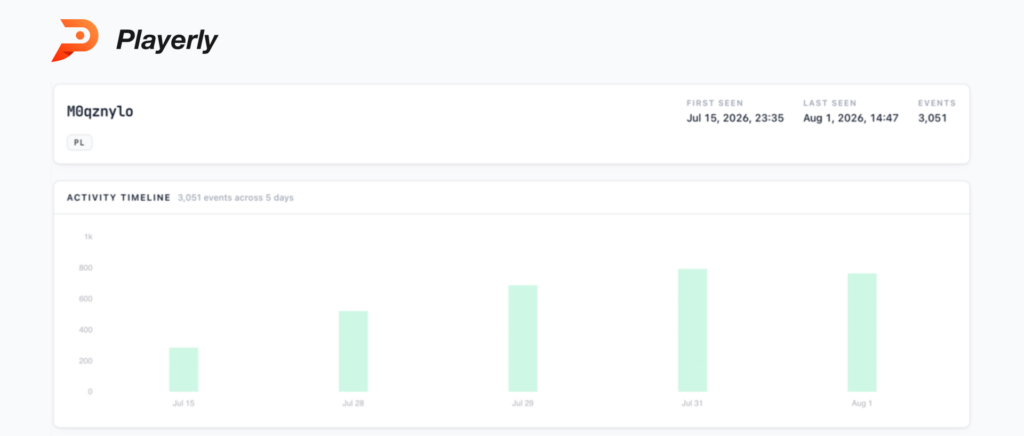
A nice extra for the provider is cross-platform tracking. You can see which other casinos your players spin at, and open any individual player to check how many spins they made in a given game.
Before and After
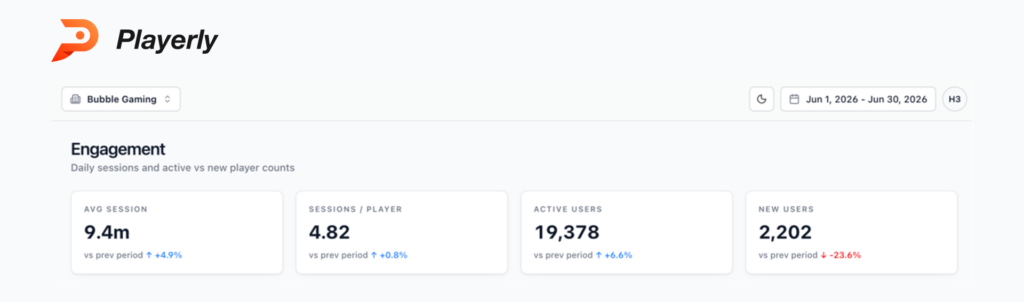
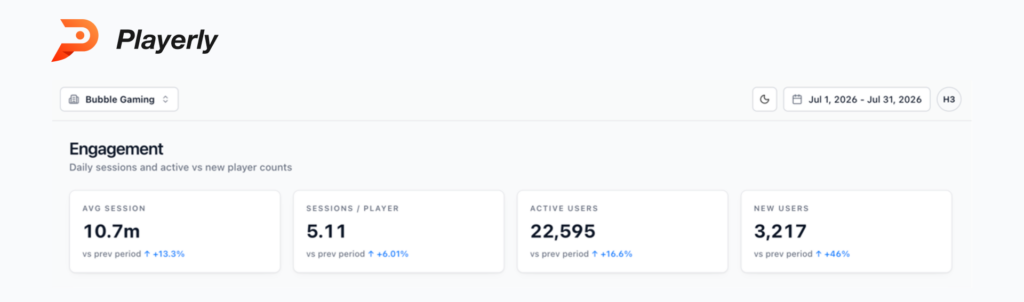
After one month of the campaign, all four Playerly engagement metrics for Bubble Gaming slots grew. New users grew the most, by 46%.
| Metric | Before (Jun 1-30, 2026) | After (Jul 1-31, 2026) | Change |
|---|---|---|---|
| Average session length | 9.4 min | 10.7 min | +13.3% |
| Average sessions per player | 4.82 | 5.11 | +6.01% |
| Active users | 19,378 | 22,595 | +16.6% |
| New users | 2,202 | 3,217 | +46% |
What Each Side Got
The provider got 1,015 new players, saw exactly how they behaved in the slots, and learned which ad funnels brought the best ones.
The buyers tested their hypotheses against real in-game data, found out which creatives bring users with higher activity, and earned an extra $20,300 from the provider on top of the main CPA income. Total revenue for the month: $700,000+ at 45% ROI.
Without shared analytics, each side would have seen only a piece of the picture: buyers would have had Meta and operator data, the provider only overall game stats. Playerly showed what happens to a player after the click. That helped buyers optimize the campaign and prove the quality of their traffic to the provider.
Key Takeaways
- Direct deals with providers are a real extra revenue stream. $20 per player on top of $140 CPA added up to $20,300 without extra spend.
- Brand awareness matters. When the provider is unknown, creatives built around the character and mechanics get clicks but not game launches. FOMO and references to well-known games worked better.
- FTD count is not the whole story. Only 20.3% of FTDs actually opened the provider’s slots, and that is the number the extra payout was tied to.
- Choose the slot with data. Retention, session length and presence in casino lobbies are a better starting point than gut feeling.
- SEO traffic is a separate audience. Players from SlotCatalog arrive already interested in a specific game.
FAQ
How much did the media buyers earn in this case?
Total revenue for July 2026 was $700,000+ on ad spend of up to $500,000, which the team puts at 45% ROI. It combined the operator’s $140 CPA for 5,000+ FTDs with an extra $20,300 from the provider.
What did the game provider pay extra for?
For a measurable in-game action: $20 for every player who made spins in Bubble Gaming slots at the operator’s casino. 1,015 players did, which gave $20,300.
Which funnels worked best?
Funnels built on FOMO (a new high-RTP game that people are winning on right now) and on references to well-known games. Creatives that showed only the character and the mechanics got clicks but few game launches.
What is Playerly used for in this case?
It tracked the player journey from the creative click to what happens inside the slot: which game was opened, how many bets, how much, how long the session lasted. Buyers and the provider watched the same dashboards.
Conclusion
The case shows a working model of direct cooperation between a provider and affiliates, where both sides come out with a profit, and both can see exactly what the player did after the click. For buyers, the main lesson is to optimize for in-game events and not only for deposits.
Want more practical iGaming guides and cases? On AffRoom you can compare ad networks, find casino affiliate programs and grab exclusive promo codes for your first campaigns.
18+. Gambling can be addictive. Check local laws and platform rules before you promote gambling products.