CPA Networks
 Ad Networks
 Affiliate Programs
 Offer base




Affiliate marketing is grounded in initial tests, all for the sake of finding the most converting channels of traffic. But large-scale tests can involve thousands of zones, and not every budget can support such an endeavor.
With this in mind, we’d like to help you reduce unnecessary costs and optimize more precisely with the help of IAB targeting for Direct Click campaigns. In the following article, we will explain IAB, elaborate on the related targeting technique, and provide a concise case study overview, from launch to final results.
This case study was prepared by RollerAds in collaboration with Affroom. Affroom is a media platform for affiliate marketers, focused on sharing real case studies, proven strategies, and up-to-date approaches to launching and scaling traffic.
If you want to stay on top of what’s actually working right now, it makes sense to follow platforms that aggregate real campaign insights and test results.
Explaining IAB targeting
IAB targeting is a method of classifying websites and online content using standardized categories developed by the Interactive Advertising Bureau (IAB). A cooking website would likely fall under the “Hobbies & Interests” category, while a blog about fitness belongs to “Health & Fitness”, and so on.
Whenever a website joins the RollerAds network, we review it and assign the most appropriate IAB category based on its content. This structurization helps affiliates and advertisers target ads more precisely, reaching audiences more likely to be interested in their offers. As a result, publishers enjoy better returns from monetization.

Advantages of IAB Targeting
IAB targeting has several benefits; we’ll name just a few below.
- Faster and more efficient testing: Instead of manually analyzing and testing thousands of zones, you can structure traffic from the very beginning and quickly identify which categories perform and which don’t.
- Simplified optimization: IAB clusters feature a few zones, meaning you can click once and turn off hundreds of underperforming zones, which is not only convenient but efficient too.
- More precise traffic control: Grouping zones by content assists with targeting and improves optimization for advertisers. Finally, it just makes navigation easier.
- Higher traffic quality: By serving ads within relevant content categories, users are more inclined to interact with offers that appeal to them. That said, the most valuable opportunities are often found in surprising categories, so ongoing testing is crucial.
Case Study Overview: RON test with IAB targeting
To see how IAB targeting performs in practice, we launched a RON test. The full case study is available on our blog, so please refer to it for more details. If you want to understand the key takeaways, keep reading.
We launched the test with two similar offers using the following setup:
- Format: Direct Click
- Vertical: VPN
- Device: Mobile
- OS: iOS
- Payout: $20
We encourage our advertisers to run a few similar offers for the same audience segment. A few similar looking offers can still perform very differently, so we recommend using the same traffic settings for a number of relatively homogenous products.
Note: IAB targeting is currently available by request — just get in touch with your manager to enable the feature. Our support team is also here for you—if any question or issue arises, we’ll help set things up properly.
Campaign Setup & Optimization by IAB Categories
During campaign creation, we indicated all the necessary parameters and ensured the necessary macros were in place to properly track IAB categories (here it’s better to consult your manager).
For IAB categories, we selected all 38 available options. This allows later optimization at the category level and helps quickly disable entire groups of underperforming zones. We launched the campaign and started waiting for results.
See the full step-by-step campaign setup on our blog.
Days 1–2
We monitored the campaign as it gained momentum and waited for sufficient statistics.
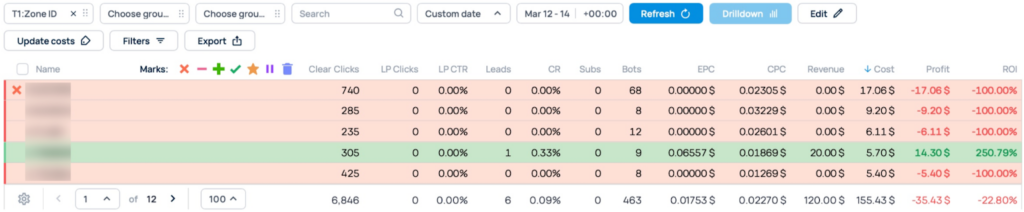
Day 3
This is when one particular zone began to stand out with lots of clicks but no conversions. We disabled it to cut the losses.
Day 4
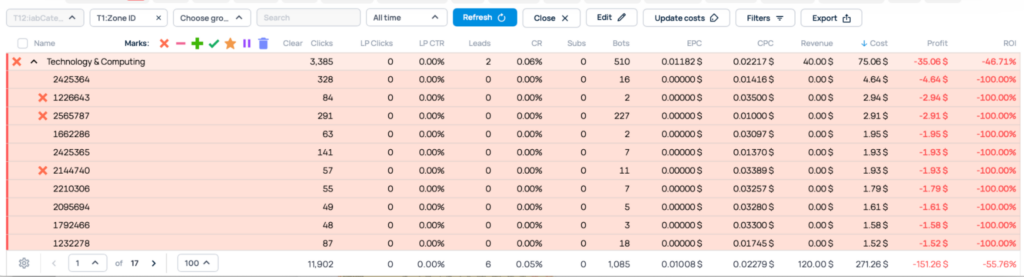
Having analyzed the IAB categories, we found a non-converting category. Turning it off removed hundreds of losing zones at once.

Day 5
This was when we parted ways with the 2nd offer, since it was performing much worse than the first, and blocked another underperforming IAB category.

Days 6 – 8
We continued to monitor and block underperforming zones and categories (including Genres, Sports, and Food & Drink).

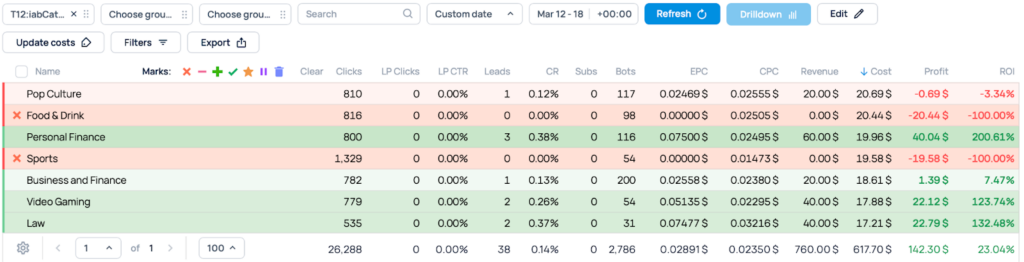
At the end of day 8, we were able to sum things up.
RON Test Results
After 8 days, the test showed the following:
- Cost: $665.45
- Revenue: $840.00
- Profit: $174.55
- ROI: 26.23%
Thanks to IAB targeting, optimization became much faster and more efficient. We not only created a solid whitelist for future scaling but also achieved a positive ROI during the test itself.
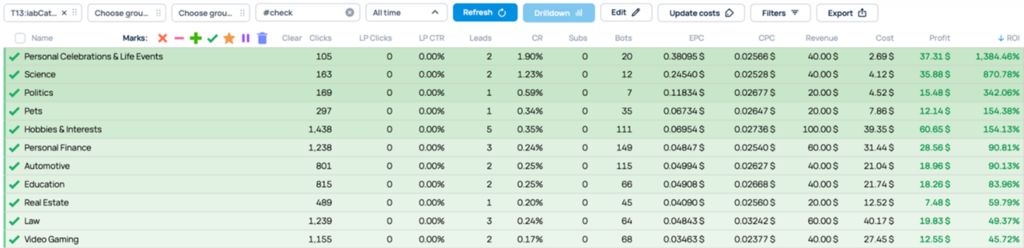
Please note, though, this whitelist is viable for this unique campaign only. If you copy-paste it without any adjustments, it might fail to deliver. That’s why we always insist on running your own tests to make sure you know your traffic.
Final Thoughts
IAB targeting proved to be a powerful tool for Direct Click campaigns. It significantly simplifies testing and optimization, helps reduce wasted spend, and allows you to focus on the traffic that actually converts.
Of course, every campaign and audience behaves differently, so we always recommend running your own tests and continuously monitoring results.
If you need help setting up IAB targeting or optimizing your campaigns, feel free to contact your manager or our support team. We’re always ready to assist.