CPA Networks
 Ad Networks
 Affiliate Programs
 Offer base




Affiliate marketing growth works because brands pay for results, and that predictable model makes scaling within margin that much more manageable.
That’s why affiliate isn’t viewed as just another channel. For many brands, it’s a core part of their growth strategy alongside paid traffic and SEO.
And yet, partner selection has become a whole lot more data-driven. When testing offers or networks, teams use platforms like AffRoom to compare programs, read through reviews, and give the boot to low-transparency partners before they even think about spending budget.
The challenge is not launching campaigns. It’s scaling them.
At a small scale, manual setups are enough. But once multiple partners, GEOs, and traffic sources are involved, limitations show up quickly:
- data is spread across different tools
- reporting is delayed
- partners don’t get feedback fast enough
In practice, this is where brands start looking for more structured setups — moving from basic affiliate programs to dedicated partnership platforms that can handle real-time tracking, attribution, and partner management at scale, as seen in solutions like Everflow.
We at Affroom worked on this article together with our partners and experts from Everflow to break down what actually works in this space based on real experience, not theory.
At that point, growth doesn’t depend on adding more traffic. It depends on how well the system behind it works.

Ad Networks: Expanding the Playing Field
Ad networks are like the all-you-can-eat buffet of affiliate marketing. They connect advertisers and affiliates, offering a smorgasbord of affiliate products to promote. Need variety? You’ll find it here.
- One dashboard to rule them all (managing multiple programs).
- Endless niches and audiences to match your vibe.
- Save time, make more money.
Looking for a starting point? Adcash brings global reach, expert backing, and fraud protection to the table. Consider it your affiliate cheat code.

From Affiliate Programs to Partnership Platforms
Affiliate marketing strategy — yeah, launching one is a breeze. Scaling it, however, that’s a whole different story altogether.
At the start, brands just manage affiliate partnerships on the fly: spreadsheets, basic tracking, reporting that’s a bit late to the party. And that setup works okay as long as your traffic levels are pretty low, but once affiliate marketing growth kicks in that’s when problems start arising.
More and more partners and channels get involved, and you start to see gaps like:
- no clear view of revenue by partner
- weak attribution across campaigns
- slow optimization due to delayed data
And at the same time, affiliates expect speed and transparency. If performance data isn’t available in real time, they just move their traffic to other affiliate platforms.
Which is why brands shift from basic affiliate programs to partnership platforms.
Partnership platforms tie all of this together. They centralise:
- all of your affiliate partnerships
- traffic and conversion data
- campaign performance across channels in one neat system
Instead of trying to manage loads of isolated campaigns, brands get a single system to control performance and scale revenue.
Platforms like Everflow support this approach by combining tracking, attribution, and partner management into one place. This lets brands move from clunky manual processes to a structured affiliate marketing strategy that’s actually built for scaling.
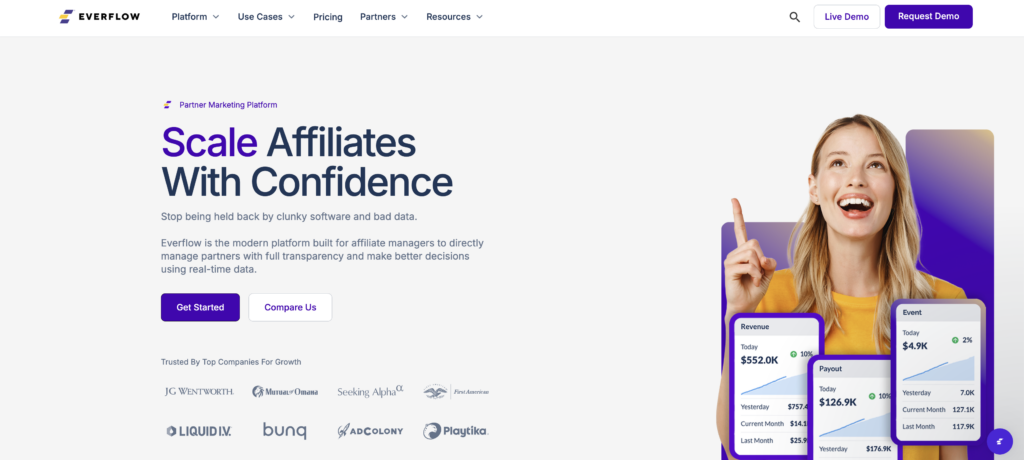
The end result is plain and simple: better control over your traffic, faster decisions, and consistent brand growth through affiliate channels.
Key Features That Drive Affiliate Marketing Growth
Not all affiliate platforms support scaling. To grow, brands need features that directly impact revenue, not just tracking.
1. Revenue-focused analytics
Affiliate marketing growth all comes down to LTV, not just conversions. The best platforms show you which affiliate partnerships bring in repeat revenue, and which ones only give you short term gains.
2. Flexible partner infrastructure
Different channels need to be set up in different ways. A good affiliate platform will support affiliates, influencers and referral partners, without limiting how they run their campaigns.
3. Automated incentives
If you want to scale then you need automation. Tiered commissions and rule-based payouts help manage affiliate partnerships without all the manual work, and keep your top partners engaged.
4. API-first data access
Data shouldn’t stay stuck inside a platform. An API-first affiliate platform lets you connect to your performance data and make decisions across channels, using the tools that you already use.
Tracking and Attribution in Affiliate Marketing Strategy
Growth in affiliate marketing depends on how accurately you can track and attribute performance. Without that, scaling is just guesswork.
| Challenge in affiliate marketing | What partnership platforms solve |
| No clear revenue by partner | Single view across all affiliate partnerships |
| Only first conversion tracked | Full funnel tracking: repeat purchases, LTV |
| Hard to evaluate traffic quality | Data by source, GEO, and user behavior |
| Slow optimization | Real-time reporting across campaigns |
| Channel conflicts | Clear attribution across all traffic sources |
With this setup, affiliate platforms become a control layer for performance.
Brands can see which affiliate partnerships drive real revenue, which channels underperform, and where to scale. This removes guesswork and speeds up decisions.
Platforms like Everflow act as a single source of truth by tracking multiple events—conversions, repeat actions, and engagement—within one system. This allows brands to identify high-ROI traffic and cut low-value sources early.
The result is a more precise affiliate marketing strategy focused on revenue, not just volume.
Affiliate Marketing Growth Strategies That Work in 2026
Affiliate marketing growth comes from execution, not expansion. Adding more partners doesn’t scale if performance is unclear.
The first shift is toward revenue-based decisions. Brands prioritize affiliate partnerships that bring repeat purchases and long-term value, not just cheap conversions. This directly impacts how budgets are allocated across channels.
The second shift is in partner selection. Content-driven partners — reviews, comparisons, niche publishers — tend to generate more stable revenue than high-volume incentive traffic. They influence decisions, not just clicks.
Speed also matters. Affiliate platforms with real-time data allow partners to optimize campaigns quickly. Delayed reporting slows down scaling and reduces partner activity.
Another pattern is scaling what already works. Instead of constantly testing new traffic sources, brands increase volume in proven segments — specific GEOs, placements, and partner types.
Finally, automation becomes part of the strategy. Managing payouts, tracking, and reporting manually limits growth. Partnership platforms remove this friction and allow affiliate programs to scale without increasing operational load.
Platforms like Everflow support this approach by combining real-time analytics, automation, and flexible partner management in one system.
The result is a structured affiliate marketing strategy focused on scaling revenue through proven channels.
Future of Affiliate Marketing and Partnership Platforms
The future of partnership marketing is being defined by AI Search Optimization (ASO).
When users ask tools like ChatGPT or Gemini for product recommendations, the responses are based on citations from review sites and listicles—most of which are created within affiliate partnerships.
This means affiliate marketing strategy now directly affects how AI models perceive, cite, and recommend a brand.
At the same time, affiliate platforms are shifting towards an API-first approach.
Platforms like Everflow let you tap into performance data from external systems, giving teams the ability to take raw affiliate data and turn it into real insights. This makes affiliate marketing growth far more connected to business decisions overall, rather than just campaign metrics.
Affiliates have always been the ones to jump on new channels early — now they are also shaping the type of content that AI models give top priority to, which makes their role in long-term brand growth even more important.
FAQ
How do brands scale growth with affiliate marketing?
Brands scale affiliate marketing growth by focusing on high-LTV partners, using real-time tracking, and reallocating budget to channels that generate repeat revenue. Partnership platforms help automate this process and remove manual bottlenecks.
What are partnership platforms in marketing?
Partnership platforms are systems that handle affiliate partnerships, tracking, attribution and payouts all in one go. They give brands one clear view of performance across all partner channels.
How do affiliate partnerships work?
Affiliate partnerships are performance-based. Partners promote a brand and earn commissions for any measurable action, sales, leads or subscriptions, as long as it’s tracked. The brand only pays for the actual results.
What are the best affiliate growth strategies?
The most effective affiliate marketing strategy focuses on LTV, prioritises content-driven partners, uses real-time data for optimization, and just scales up proven traffic sources rather than constantly trying out new ones.
Can affiliate marketing drive long-term growth?
Yes, it can. Affiliate marketing can drive long-term growth when brands track the full value of the user, work with good quality partners and use accurate attribution to scale profitable channels.
Conclusion
Affiliate marketing growth today depends on structure, not just traffic. Brands that scale treat affiliate partnerships as a core channel, supported by data, clear attribution, and fast optimization.
This is where partnership platforms become critical. Instead of managing fragmented campaigns, brands get a single system to track performance, identify high-ROI traffic, and scale what works.
Platforms like Everflow are built for this stage. By combining affiliate management, influencer tracking, and multi-channel attribution, they give brands real-time visibility into performance and automate partner operations at scale. This allows teams to focus on growth instead of manual processes.
If your current setup limits scaling, it’s a signal to upgrade the system behind your affiliate marketing strategy.