CPA Networks

 Ad Networks

 Affiliate Programs

 Offer base





Which country gambles the most? There is no single answer, because “most” can mean three different things. By total revenue, it is the United States, with a record $78.7 billion in commercial gaming revenue in 2025. By money lost per person, it is Australia, at about A$1,635 per adult a year, the highest in the world. And by the share of people betting online, it is South Africa, where 32.3% of internet users visit a gambling or betting site or app in a typical month.
This guide ranks the 11 biggest gambling markets using the latest official and industry data, then breaks the picture down by metric: who earns the most, who loses the most per person, and where the largest share of the population plays. It also covers what changed in 2026. Brazil banned fixed-odds betting in September, India’s ban on real-money online games took effect in May, the UK raised online gambling taxes, Australia passed new advertising limits, and Macau’s recovery lost momentum.
Last updated: November 3, 2026. Figures are the latest full-year data from regulators and industry bodies, plus 2026 year-to-date data where it exists. Sources are listed at the end of the article.
This research was prepared by AffRoom — a platform focused on the iGaming industry, affiliate ecosystem, and gambling market analytics. AffRoom tracks verified market trends, industry data, and gambling statistics to help readers better understand how the global casino and betting industry is evolving in 2026.

Key Takeaways
- Biggest by revenue: the United States, with a record $78.7 billion in commercial gaming revenue in 2025 (American Gaming Association). The total excludes tribal casinos and lotteries.
- Biggest casino hub: Macau, with MOP 247.4 billion ($30.9 billion) in 2025, about 85% of its 2019 level. In 2026 growth has stalled: revenue fell year on year for four months in a row through September.
- Biggest losses per person: Australia, at about A$1,635 (US$1,099) per adult per year, roughly double the US level. Total losses hit a record A$36 billion in 2025–26.
- Highest share of people betting online: South Africa, where 32.3% of internet users aged 16+ visited a gambling site or app in the previous month, ahead of Ghana (21.5%) and Nigeria (18%), according to GWI.
- Fastest-growing regulated markets: US iGaming states (+27.6% in 2025) and Ontario, Canada (+34%).
- Two big markets closed in 2026: India banned real-money online games on 1 May, and Brazil banned fixed-odds betting, including online casino, on 25 September. Brazil’s ban is now before the Supreme Court and Congress.
- Compare numbers carefully: some figures below are gross gaming revenue (what players lose), others are wagers or turnover (what players stake), which is far larger. We label each one.

Biggest Gambling Countries at a Glance
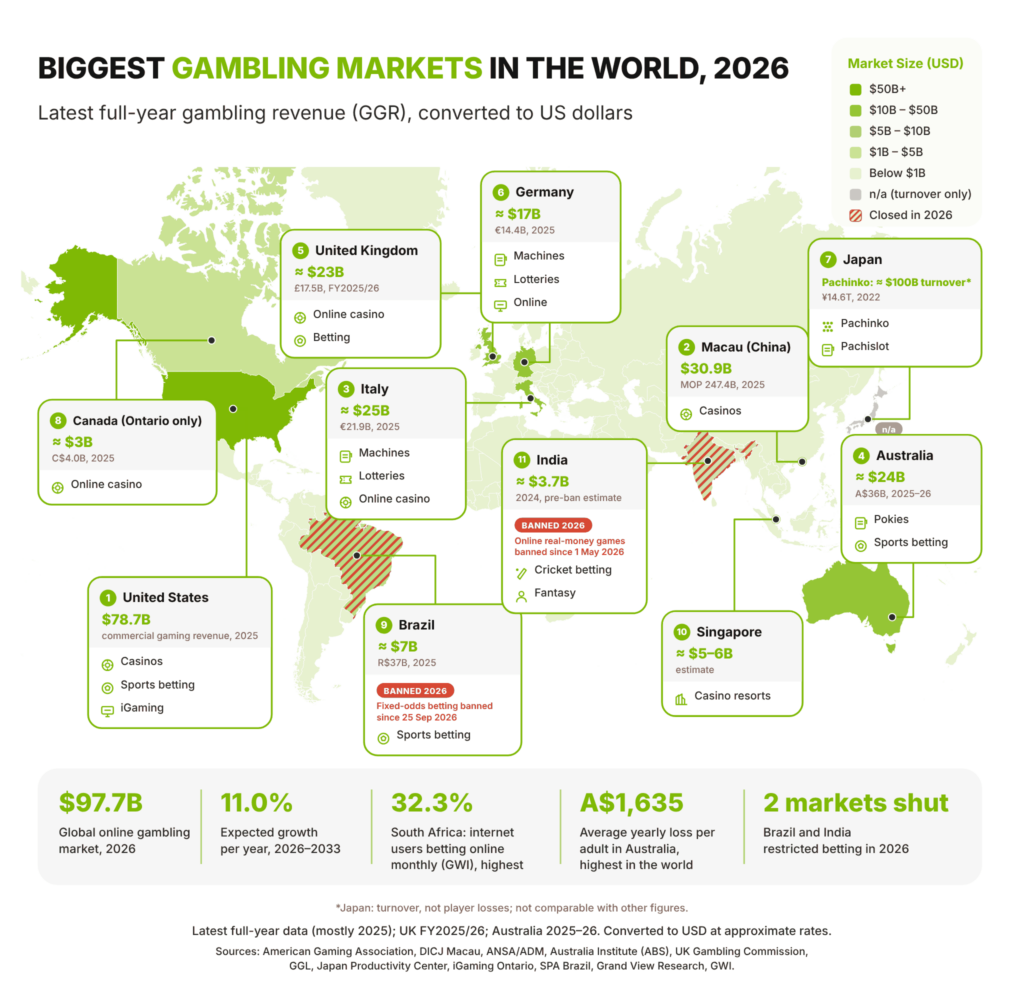
The table summarizes the 11 markets in this ranking, ordered by latest market size in US dollars. Metrics differ by country, so use it to compare scale, not as an exact like-for-like leaderboard. Positions 3 to 5 are within about $2 billion of each other and can swap with exchange rates.
| # | Country | Latest market size | Main segment | Regulator / online status |
| 1 | United States | $78.7B commercial gaming revenue (2025) | Land-based casinos; sports betting and iGaming growing fastest | State regulators; online casino legal in 7 states |
| 2 | Macau (China) | $30.9B gross gaming revenue (2025) | Land-based casinos | DICJ; 6 concessionaires |
| 3 | Italy | €21.9B (≈ $25B) player losses (2025) | Machines, lotteries and online casino | ADM; fully regulated; advertising ban |
| 4 | Australia | A$36B (≈ $24B) net losses (2025–26) | Poker machines (pokies) and sports betting | States + federal rules; online casino banned |
| 5 | United Kingdom | £17.5B (≈ $23B) gross gambling yield (FY2025/26) | Online casino and betting | UKGC; fully regulated |
| 6 | Germany | €14.4B (≈ $17B) gross gaming revenue (2025) | Land-based machines and lotteries (75% of market) | GGL; strict stake and deposit limits |
| 7 | Japan | ¥14.6T (≈ $100B) pachinko turnover (2022); not comparable | Pachinko and pachislot | Tightly controlled; first casino planned for 2030 |
| 8 | Canada | C$4.0B (≈ US$3B) Ontario iGaming revenue (2025) | Online casino | Provincial (AGCO / iGaming Ontario) |
| 9 | Brazil | R$37B (≈ $7B) gross gaming revenue (2025) | Sports betting | Fixed-odds betting banned since 25 Sept 2026 (under legal challenge) |
| 10 | Singapore | ≈ $5–6B casino revenue (industry estimates) | Integrated resorts | CRA; 2 licensed casinos |
| 11 | India | ≈ $3.7B online real-money gaming (2024, pre-ban) | Cricket betting and fantasy sports | Real-money online games banned since 1 May 2026 |
How We Ranked the Biggest Gambling Countries
There is no official ranking of the most gambling country in the world, because regulators and researchers measure different things. Gross gaming revenue (GGR), also called gross gambling yield or player losses, is the amount wagered minus winnings paid out. Handle or turnover is the total amount wagered, which is many times larger. Participation counts how many people gamble, and per-adult losses show how much the average person loses. The answer changes depending on which one you pick.
We ordered the markets by their latest GGR converted to US dollars, mostly full-year 2025 data, with newer fiscal-year data for the UK (April 2025 to March 2026) and Australia (2025–26). Conversions are approximate, periods differ by regulator, and some figures include lotteries while others do not. Where a number is not comparable, such as Japan’s pachinko turnover or Ontario’s single-province revenue, we say so.
| Metric | What it tells you |
| Gross gaming revenue (GGR) | The size of the market: what players lose in total |
| Handle / turnover | How much is staked; much larger than GGR and not comparable with it |
| Losses per adult | How deeply gambling is embedded in daily life, and a proxy for player value |
| Participation rate | How many people gamble, whatever they spend |
| Online share and growth | Where the market is heading, especially sports betting and iGaming |
| Regulatory risk | Bans, tax rises and licensing changes can reshape a market within months |
Online is the growth engine. Grand View Research values the global online gambling market at $88.0 billion in 2025 and $97.7 billion in 2026, rising to $202.8 billion by 2033, a growth rate of 11.0% a year. Europe holds about 41% of the market and Asia Pacific is expected to grow fastest. Regulation is the wildcard: Brazil went from a licensed market to a ban in under two years, and India closed its market in 2026.
Gambling is also a public-health issue. A 2024 meta-analysis of survey studies (Tran et al.) found that nearly half of adults gamble in a given year and that about 1.4% of adults, roughly 72 million people, have problematic gambling.
Top 11 Biggest Gambling Countries in the World
The biggest gambling markets combine mature casino economies, fast-growing online betting and countries with a long gambling tradition. Below, each market gets the same treatment: the latest figures, what drives them, and the regulatory context that matters in 2026.
1. United States
The United States is the biggest gambling country in the world by revenue and has the largest casino footprint, with more than 1,000 commercial and tribal casinos. According to the American Gaming Association (AGA), commercial gaming revenue reached a record $78.7 billion in 2025, up 9.2%, and all 38 commercial markets grew. The figure covers commercial casinos, sportsbooks and online casinos. It leaves out tribal gaming, lotteries and prediction markets.
Almost all the growth is online. Land-based casinos, racinos and riverboats earned $50.9 billion (+2.3%). Sports betting earned $17.0 billion (+22.8%) on $166.9 billion wagered, and online casino (iGaming) earned $10.7 billion (+27.6%) in just seven states. Gaming taxes reached a record $18.1 billion. Nevada is still the largest single market at $15.8 billion, followed by Pennsylvania ($7.7 billion), New Jersey ($7.0 billion), New York ($5.7 billion) and Michigan ($5.0 billion).
| Metric | Data |
| Commercial gaming revenue | $78.7B (2025, +9.2%) |
| Land-based casinos | $50.9B (+2.3%) |
| Sports betting revenue | $17.0B (+22.8%); handle $166.9B |
| iGaming revenue | $10.7B (+27.6%), 7 states |
| Gaming taxes | $18.1B (+15.1%) |
| Largest state market | Nevada, $15.8B |
| Number of casinos | 1,000+ (commercial and tribal) |
| Regulation | State by state (38 commercial markets) |
Online casino is legal in only seven states, so every new legalization is a major growth lever. A newer challenge is prediction markets that offer sports event contracts outside state licensing: the AGA estimates they have already diverted more than $500 million in potential sports betting tax revenue. Participation is broad. In the AGA’s 2025 consumer survey, 57% of American adults said they had gambled in the past year, and 53% had visited a casino.
2. Macau (China)
Macau is the world’s largest casino hub and the only place in China where casino gambling is legal. According to the Gaming Inspection and Coordination Bureau (DICJ), its casinos earned MOP 247.4 billion ($30.9 billion) in 2025, up 9.1% and the best year since the pandemic, but still only about 85% of the 2019 level (MOP 292.5 billion). Mass-market players brought in roughly 73% of the revenue.
2026 has been a story of two halves. Revenue rose 14.3% in the first quarter, then slowed: June fell 12.1% year on year, and September (MOP 18.06 billion, or $2.23 billion) was down 1.2%, the fourth monthly decline in a row. Over the first nine months of 2026, revenue reached MOP 181.3 billion ($20.95 billion), about level with the same period of 2025. The government’s budget assumes MOP 236 billion for the full year, about 4.6% below 2025, and analysts say that target is still within reach. Earlier forecasts of 5–6% growth have been trimmed.
| Metric | Data |
| Gross gaming revenue (2025) | MOP 247.4B ($30.9B) |
| Growth vs 2024 | +9.1% |
| Recovery vs 2019 | ~85% |
| January–September 2026 | MOP 181.3B ($20.95B), about level with 2025 |
| Mass-market share of revenue (2025) | ~73% |
| Licensed operators | 6 concessionaires |
| Main visitors | Mainland China tourists |
The six concessionaires are Sands China, Wynn, MGM, Galaxy, Melco and SJM. Despite the global shift online, Macau still depends almost entirely on offline casinos.
What about mainland China? Casinos and online gambling are illegal there, but the state lottery is enormous: the Ministry of Finance reports record lottery sales of CNY 6.28 trillion (about $90 billion) in 2025, with more than 300 million registered players and sports lotteries making up roughly two-thirds of sales. That is turnover, and most of it goes back out as prizes, welfare funds and costs, so it is not comparable with casino revenue. Unlicensed gambling exists but cannot be measured reliably, which is why we do not rank mainland China separately.
3. Italy
Italy is one of Europe’s biggest gambling markets, and gambling is part of the culture: the state-run Lotto has existed in some form since the 1700s. Italians lost about €21.9 billion (roughly $25 billion) in 2025, according to a report by Italy’s largest trade union and a consumer group built on official data, from record wagers of about €164.6 billion (+4.6%). That makes Italy Europe’s largest gambling market by gross gaming revenue, ahead of the UK.
Online is now the bigger channel by volume. Online wagers passed €100 billion for the first time in 2025 (€100.9 billion, +9.5%), more than 60% of the total. Online casino, poker and bingo players spent about €3.3 billion on €77.9 billion of stakes. Regulated gambling paid €11.5 billion to the state treasury.
| Metric | Data |
| Player losses (GGR) | €21.9B (2025) |
| Total wagers | €164.6B (+4.6%) |
| Online wagers | €100.9B (+9.5%), ~61% of total |
| Online casino, poker and bingo spend | ~€3.3B |
| Tax revenue | €11.5B |
| Regulation | ADM; fully regulated |
Italy is also a case study in strict regulation. The 2019 Dignity Decree bans almost all gambling advertising and sponsorship, so a large market does not mean easy customer acquisition. Online licensing was reopened under a new framework (Legislative Decree 41/2024) in November 2025, and the regulator, ADM, blocked more than 1,000 unauthorized gambling sites in 2025.
4. Australia
Australia is the world’s biggest gambling loser per person. Poker machines (“pokies”) sit in pubs and clubs across most states, and online sports betting has grown fast. Australians lost a record A$36 billion (about US$24 billion) to gambling in 2025–26, A$1.2 billion more than the year before, according to the Australia Institute’s analysis of Australian Bureau of Statistics data. Per adult, the Grattan Institute puts annual losses at A$1,635 (about US$1,099), against A$809 in the United States and A$584 in New Zealand.
Pokies account for about half of all losses, and New South Wales alone has more than 87,000 of them. Online gambling is the fastest-growing part: the share of adults gambling online rose from 8% in 2017 to 33% in 2025. Online casino games are banned under the Interactive Gambling Act, but many Australians use offshore sites.
| Metric | Data |
| Net gambling losses | A$36.0B (12 months to March 2026) |
| Losses per adult | A$1,635 (about US$1,099), highest in the world (Grattan Institute) |
| Share of losses on pokies | About half |
| Adults gambling online | 33% (2025), up from 8% in 2017 |
| Regulation | State regulators plus federal rules (ACMA); online casino banned |
| New advertising rules | Passed August 2026, in force from 1 January 2027 |
New limits are coming. In August 2026, Parliament passed the Interactive Gambling Amendment (Gambling Reform) Bill, which takes effect on 1 January 2027. Under the final deal, television gambling ads are capped at three per hour between 5 am and 8:30 pm, banned during live sport and for 15 minutes before a game, and barred from stadiums and player jerseys. Reports on the deal also say commissions to staff or affiliates based on customer activity will be outlawed. Campaigners wanted the total advertising ban that a 2023 federal inquiry had recommended.
5. United Kingdom
The UK is one of the most mature online gambling markets in the world, and the UK Gambling Commission (UKGC) licenses every operator serving British players. Great Britain’s gambling industry generated £17.5 billion (about $23 billion) in gross gambling yield in the financial year April 2025 to March 2026, up 4.4%, another record and the fifth straight year of growth. Online casino alone brought in £5.7 billion, up £736 million, while land-based sectors grew only 1.1%.
Participation is high. In the Commission’s Gambling Survey for Great Britain, 47% of adults had gambled in the previous four weeks, and 26% once you remove people who only played a lottery draw. The same survey puts problem gambling (a PGSI score of 8 or more) at 2.4% of adults in 2025, down from 2.7% the year before.
| Metric | Data |
| Gross gambling yield | £17.5B (FY2025/26, +4.4%) |
| Online casino yield | £5.7B (+£736M) |
| Land-based sectors | +1.1% |
| Adults who gambled in past 4 weeks | 47% (26% excluding lottery-only players) |
| Problem gambling (PGSI 8+) | 2.4% of adults (2025) |
| Online casino tax (Remote Gaming Duty) | 40% since April 2026 (was 21%) |
| Regulation | Fully regulated (UKGC) |
Taxes are now the main story. Remote Gaming Duty, the tax on online casino, rose from 21% to 40% in April 2026, bingo duty was abolished, and a new 25% rate on remote betting starts in April 2027. In the Autumn Budget on 28 October 2026, the Chancellor also raised Machine Games Duty from 20% to 25%, less than the doubling the industry had feared. The 2025–26 figures above predate the biggest changes, so operators’ responses, such as shop closures and cost cutting, will show up in next year’s statistics.
6. Germany
Germany is Europe’s biggest economy and one of its largest gambling markets, but a tightly controlled one. Since the 2021 Interstate Treaty on Gambling, online casino games and sports betting are licensed by the national regulator, the GGL, with some of the strictest player limits in the world. The GGL reports that the legal market earned €14.4 billion (about $17 billion) in gross gaming revenue in 2025, flat on 2024 after 5% growth the year before. Land-based gambling made up €10.9 billion (75%) and online gambling €3.5 billion (+2%). Gaming machines accounted for €4.9 billion and state lotteries for €4.2 billion.
| Metric | Data |
| Gross gaming revenue | €14.4B (2025, flat) |
| Land-based revenue | €10.9B (75%) |
| Online gambling revenue | €3.5B (+2%) |
| Virtual slots revenue | €543M (+11%); stakes €4.6B |
| Regulation | Interstate Treaty; GGL |
The rules explain the numbers: a €1 maximum stake per virtual slot spin, a five-second minimum spin time, a €1,000 monthly deposit limit, a national self-exclusion system (OASIS), and no live dealer casino under the federal framework. Even so, licensed virtual slots grew 11% in 2025. The limits also push some players offshore. The GGL estimates the illegal online market at €500–600 million and the legal share of online play at about 77%, while industry voices such as Tipico dispute that and put the black market far higher.
7. Japan
Japan’s market looks different from every other on this list. The Criminal Code bans most gambling and no casino has opened yet, but pachinko, pachislot, government-run races (horse, powerboat, bicycle and motorcycle) and lotteries are legal. Pachinko and pachislot dominate: Japan’s Leisure White Paper 2023 puts their ball-rental sales at about ¥14.6 trillion (roughly $100 billion) in 2022. That is turnover, the money exchanged for balls and tokens, not what players lose. Net losses are far smaller, so Japan cannot be compared directly with the revenue figures for other countries.
It is also a shrinking market. About 7.7 million people played in 2022, against 8.8 million in 2019 and 21.7 million in 2002, and the number of companies running pachinko parlors roughly halved between 2014 and 2023, from about 3,700 to 1,830.
| Metric | Data |
| Pachinko and pachislot turnover | ¥14.6T (≈ $100B, 2022), flat for two years |
| Players | 7.7M (2022) vs 8.8M (2019) |
| Companies running parlors | ~1,830 (2023) vs ~3,700 (2014) |
| Online gambling | Not licensed |
| First casino | MGM Osaka, scheduled for autumn 2030 |
The first casino is on its way. MGM Osaka, built by MGM Resorts and Orix on Yumeshima island, broke ground in April 2025 and is scheduled to open in autumn 2030, with a budget of about ¥1.27 trillion ($8.9 billion).
8. Canada
Canada is one of the fastest-growing regulated gambling markets in North America. Parliament legalized single-event sports betting in August 2021, and Ontario opened a competitive, privately operated online market in April 2022. According to iGaming Ontario, licensed operators handled about C$98.3 billion in wagers in 2025 (+26%) and earned C$4.0 billion (about US$3 billion) in gross revenue (+34%). Online casino is the engine: C$3.15 billion, up 40% and roughly 78% of the total.
| Metric | Data |
| Ontario iGaming revenue | C$4.04B (2025, +34%) |
| Ontario wagers | C$98.3B (+26%) |
| Online casino revenue | C$3.15B (+40%), ~78% of total |
| Active player accounts | 1.28M (+25%) |
| Revenue per active account | C$334 (from C$263) |
| Revenue since April 2022 launch | C$10B+ |
| Regulation | Provincial (AGCO / iGaming Ontario) |
These numbers cover Ontario only, not a national total, and Canada’s market also includes provincial lotteries, casinos and sports betting. Because gambling is regulated province by province, rules differ across the country, and other provinces such as Alberta are moving toward Ontario-style frameworks. A record C$9.5 billion was wagered in Ontario in January 2026 alone.
9. Brazil
Brazil became one of the fastest-growing gambling markets in the world after it launched regulated fixed-odds betting on 1 January 2025, and then, in September 2026, it shut that market down. In the first full year, according to the Secretariat of Prizes and Bets (SPA), 79 licensed operators reported R$37 billion (about $7 billion) in gross gaming revenue from 25.2 million bettors, 68% of them men, and paid close to R$10 billion in federal taxes. Football betting made up the biggest share.
On 25 September 2026, President Lula signed Provisional Measure 1,394/2026, which bans the operation, offering, intermediation and advertising of fixed-odds betting, covering both sports betting and online casino games, including offshore operators. Licensed sites had to go offline by 6 October, and the remaining licences lapsed on 25 October. By late October, the Ministry of Justice had referred more than 16,600 illegal betting sites for blocking.
| Metric | Data |
| Gross gaming revenue (2025) | R$37B (~$7B) |
| Bettors (2025) | 25.2M (68% men) |
| Licensed operators (2025) | 79 |
| Federal tax paid (2025) | ~R$10B (GGR tax 12%, 13% in 2026) |
| Market status | Fixed-odds betting banned since 25 Sept 2026 (MP 1,394/2026) |
| Supreme Court | Public hearing on 3 November 2026 |
| Congress | Initial deadline to vote: 23 November 2026 |
The ban is not settled. The Supreme Federal Court holds a public hearing on 3 November on industry challenges, but Justice Luiz Fux has not suspended the measure and has no deadline to rule. Congress has until 23 November to consider it, and that period can be extended once by 60 days. Lula, re-elected on 25 October, has said he doubts Congress will overturn the ban. One compromise reported in Congress would allow sports betting but not online casino, though nothing is confirmed. Because the situation changes quickly, check official sources before making plans in this market.
10. Singapore
Singapore remains one of Asia’s most profitable casino markets despite its small population. The market is a duopoly of two integrated resorts that opened in 2010, Marina Bay Sands and Resorts World Sentosa. They earn most of their money from international visitors, while citizens and permanent residents must pay an entry levy to play. Industry estimates put annual casino gaming revenue at roughly $5–6 billion, with Marina Bay Sands taking the larger share. That is not an official figure, so treat it as an estimate.
| Metric | Data |
| Casino gaming revenue | ≈ $5–6B a year (industry estimates) |
| Licensed casinos | 2 (Marina Bay Sands, Resorts World Sentosa) |
| Main audience | International tourists |
| Regulation | Casino Regulatory Authority (CRA) |
Both resorts are expanding. Las Vegas Sands broke ground in 2025 on an $8 billion expansion of Marina Bay Sands due to open in 2031, and Genting Singapore is investing S$6.8 billion in transforming Resorts World Sentosa.
11. India
India has one of the world’s largest online gaming audiences, with more than 900 million internet users, cheap mobile data and a cricket-obsessed population. But it is no longer a legal market for real-money online games. The Promotion and Regulation of Online Gaming Act, 2025 bans online money games of every kind, including fantasy sports, rummy, poker, betting and online casino, whether they depend on skill or chance, and it bars advertising them and processing payments for them. The Act and its 2026 Rules came into force on 1 May 2026, and operators face up to three years in prison and a ₹1 crore fine.
Before the ban, estimates put India’s real-money online gaming industry at about $3.7 billion in 2024 (IMARC Group), with real-money games making up around 85% of online gaming revenue. That is why India still appears in this ranking, in last place and with a caveat: its pre-ban market was large, but it is now closed.
| Metric | Data |
| Online gaming market (2024, pre-ban) | ≈ $3.7B (estimate) |
| Main segment | Cricket betting and fantasy sports |
| Internet users | 900M+ |
| Real-money online games | Banned since 1 May 2026 |
| Land-based casinos | Allowed only in a few places (Goa, Sikkim, Daman) |
| Legal status | Central ban; challenges before the Supreme Court |
The Supreme Court agreed in August 2026 to hold a final hearing on petitions challenging the Act, so the legal position could still change. In May 2026 it also upheld the 28% GST on the full face value of stakes for online money gaming. Industry groups warn that the ban will push millions of players to offshore sites, which sit outside any regulation or player protection. Cricket events such as the IPL remain the biggest source of betting interest.
Which Countries Gamble the Most? Rankings by Different Metrics
The answer to “which country gambles the most?” depends on the metric. Total revenue favors the biggest economies, per-person losses favor places where gambling is part of everyday life, and participation rates favor markets where betting is cheap and mobile-first.
| Metric | Leader | Key figure |
| Total gambling revenue | United States | $78.7B commercial gaming revenue (2025) |
| Casino revenue in a single destination | Macau | $30.9B gross gaming revenue (2025) |
| Largest market in Europe | Italy | ≈ €21.9B player losses (2025) |
| Losses per adult | Australia | A$1,635 per adult per year |
| Share of internet users betting online | South Africa | 32.3% in a typical month (GWI, Q2 2025) |
| Fastest-growing regulated online market (2025) | Canada (Ontario) | +34% operator revenue to C$4.0B |
| Fastest-growing US segment (2025) | US iGaming | +27.6% to $10.7B |
| Most casinos | United States | 1,000+ commercial and tribal casinos |
| Biggest machine-gaming culture | Japan | ¥14.6T pachinko and pachislot turnover (2022) |
Where Do the Most People Gamble? Participation by Country
Revenue shows where the money is. Participation shows how many people take part, and the two do not always match. Surveys use different definitions, so read the table as separate snapshots, not as one ranking.
| Country | What is measured | Share |
| South Africa | Internet users 16+ who visited an online gambling or betting site or app in the past month (GWI, Q2 2025) | 32.3% |
| Ghana | Same measure | 21.5% |
| Nigeria | Same measure | 18% |
| United Kingdom | Adults who gambled in the past four weeks (Gambling Survey for Great Britain, Sept 2025 to Jan 2026) | 47% (26% excluding lottery-only players) |
| United States | Adults who gambled in the past year (AGA 2025 consumer survey) | 57% |
| Australia | Adults who gamble online (2025) | 33% |
South Africa shows how participation and revenue can differ. It tops GWI’s 48-country list for online gambling, but its market is far smaller than the giants above: gross gambling revenue was R75 billion (about $4.3 billion) in 2024/25, and betting made up about 70% of it. The South African Reserve Bank reports that online betting alone generated R44 billion in GGR that year, up from R29 billion, or 85.5% of betting revenue. GWI measures site visits, not spending or the number of bets.
Across Africa, regulated online gambling revenue reached $5.2 billion in 2025 (Gaming Compliance International). Nigeria, with a much bigger population, had an estimated $1.1 billion in online gross gambling win in 2025 (H2 Gambling Capital). Governments are noticing: South Africa floated a 20% national tax on online gambling revenue in a November 2025 discussion paper, and a dozen African countries have introduced or proposed major gambling tax changes since 2025.
Gambling Losses per Adult
Per-adult losses show where gambling is most deeply embedded in daily life, and where each player is worth the most to operators. The most reliable recent comparison comes from the Grattan Institute’s 2024 report on preventing gambling harm.
| Country | Average annual loss per adult | Approx. in US dollars |
| Australia | A$1,635 | ~US$1,099 |
| United States | A$809 | ~US$544 |
| New Zealand | A$584 | ~US$392 |
Australia is the clear outlier, losing roughly twice as much per adult as the United States. Older comparisons based on H2 Gambling Capital estimates put Singapore, Ireland and Finland among the next-highest, but they come from different years and methods, so we do not rank them here. For operators and affiliates, per-adult spend is a proxy for player value: a small, high-spending market can outperform a larger, low-spending one.
Responsible Gambling and Player Protection by Country
Gambling disorder is recognized by the World Health Organization, and the biggest markets are tightening their rules. Here is what is in force or announced for 2025–2026.
| Country | Key player-protection measure or policy change |
| United States | Regulated state by state; limits and self-exclusion programs differ across states. |
| United Kingdom | Affordability checks and strict advertising rules under the UKGC. Problem gambling is 2.4% of adults (2025). Online casino tax rose to 40% in April 2026. |
| Germany | €1 stake cap per slot spin, five-second minimum spin time, €1,000 monthly deposit limit and the OASIS self-exclusion system. |
| Italy | Near-total ban on gambling advertising and sponsorship (Dignity Decree, 2019). |
| Australia | Reform law passed in August 2026, effective 1 January 2027: three TV ads per hour, no ads during live sport, no ads on stadiums or jerseys. |
| Brazil | Fixed-odds betting banned since 25 September 2026; the ban is under legal challenge. |
| India | Nationwide ban on real-money online games, their advertising and related payments (since 1 May 2026). |
If gambling is causing harm to you or someone close to you, contact your national gambling helpline or local health service for free, confidential support.
Online Gambling Trends in 2026
The industry keeps moving online. US iGaming revenue grew 27.6% in 2025, Ontario’s grew 34%, and online games now account for more than 60% of all wagers in Italy. These are the trends shaping the market in 2026.
1. Mobile Betting Dominates
Most online betting now happens on phones. In Brazil, more than 70% of wagers were placed on mobile devices before the ban, and mobile-first betting is also behind the participation surge in African markets such as South Africa, Nigeria and Ghana.
2. Big “Next Markets” Closed Within Months
Brazil and India were widely expected to become the next major growth drivers. Instead, India banned real-money online games on 1 May 2026, and Brazil banned fixed-odds betting on 25 September 2026. The episode shows how quickly regulation can change a market’s outlook, and why diversifying across regions matters for operators and affiliates.
3. Higher Taxes and Tighter Rules
Governments keep raising the cost of operating. The UK lifted Remote Gaming Duty from 21% to 40% in April 2026, will tax remote betting at 25% from April 2027 and raised Machine Games Duty to 25% in October. Brazil’s GGR tax rose to 13% in 2026 before the ban, Italy bans most gambling advertising, and Australia’s new advertising limits start on 1 January 2027.
4. Online Casino Is Outgrowing Sports Betting in Several Markets
In the US, iGaming revenue grew 27.6% in 2025 against 22.8% for sports betting. In Ontario, online casino revenue rose about 40% and now makes up roughly four-fifths of the market. In Great Britain, online casino yield rose £736 million to £5.7 billion.
5. Prediction Markets Challenge Regulated Sportsbooks
In the United States, event-contract platforms now compete for sports wagering demand outside state licensing. The AGA estimates that prediction markets have already diverted more than $500 million in potential sports betting tax revenue, and the industry argues that sports betting should stay under state and tribal regulation.
6. Offshore and Black Markets Remain a Challenge
Even in tightly regulated markets, many players use unlicensed sites. Germany’s regulator estimates the illegal online market at €500–600 million, while operators argue it is several times larger. Estimates suggest up to €25 billion in wagers still flow through unlicensed sites in Italy each year, Brazil’s Ministry of Justice referred more than 16,600 illegal betting sites for blocking within a month of the ban, and many Australians use offshore casinos because online casino games are banned at home.
7. Africa Becomes a Participation Hotspot
South Africa, Ghana and Nigeria all sit in the top 10 of GWI’s online gambling participation ranking, and Africa’s regulated online gambling revenue reached $5.2 billion in 2025. Rising taxes are the counterweight, as a dozen African countries have introduced or proposed tax increases since 2025.
FAQ
Which country gambles the most in the world?
It depends on the metric. The United States earns the most: a record $78.7 billion in commercial gaming revenue in 2025. Australia loses the most per person: about A$1,635 per adult a year, roughly double the US level. South Africa has the highest share of internet users betting online: 32.3% in a typical month, according to GWI.
What are the top 10 gambling countries in the world?
By latest market size, the ten biggest are the United States, Macau (China), Italy, Australia, the United Kingdom, Germany, Japan, Canada, Brazil and Singapore, roughly in that order. India would also rank in the lower part of the list on its pre-ban market, but it banned real-money online games in May 2026. Positions 3 to 5 are very close and depend on exchange rates, and Japan’s figure is turnover, not losses.
Which country has the highest gambling losses per person?
Australia. The Grattan Institute puts average losses at A$1,635 per adult per year, compared with A$809 in the United States and A$584 in New Zealand.
Which country has the highest percentage of gamblers?
It depends on how participation is measured. For online gambling, South Africa leads GWI’s 48-country ranking: 32.3% of internet users aged 16+ visited a gambling or betting site or app in the previous month, ahead of Ghana (21.5%) and Nigeria (18%). That measures visits, not spending. In official national surveys, 57% of US adults gambled in the past year, and 47% of British adults gambled in the past four weeks (26% excluding lottery-only players).
Which countries have the most casinos?
The United States has the largest number of casinos, with more than 1,000 commercial and tribal properties. Macau earns the most casino revenue of any single destination, at $30.9 billion in 2025.
Is gambling legal in China?
Not on the mainland, apart from state-run lotteries, which sold a record CNY 6.28 trillion (about $90 billion) of tickets in 2025. Casino gambling is legal in Macau, a special administrative region, where six licensed concessionaires operate.
Is online gambling legal in India in 2026?
No. The Promotion and Regulation of Online Gaming Act, 2025 bans real-money online games, including fantasy sports, rummy, poker and betting, along with their advertising and payment processing. The Act and its 2026 Rules came into force on 1 May 2026. The Supreme Court agreed in August 2026 to hold a final hearing on challenges to the law. Land-based casinos are allowed only in a few places, such as Goa, Sikkim and Daman.
Is online betting still legal in Brazil?
Not for fixed-odds betting. Provisional Measure 1,394/2026, signed on 25 September 2026, bans the operation, offering, intermediation and advertising of fixed-odds betting, including online casino games and offshore operators. The Supreme Federal Court holds a public hearing on 3 November, and Congress has until 23 November to consider the measure, with a possible 60-day extension. The situation may change, so check official sources.
Which gambling market is growing the fastest?
Among regulated markets, Ontario (Canada) and the US iGaming states grew fastest in 2025: Ontario operator revenue rose 34% to C$4.0 billion, and US iGaming revenue rose 27.6% to $10.7 billion. Brazil was the fastest-growing new market in 2025 but is now banned, and Macau’s growth has stalled in 2026.
Which country has the biggest gambling addiction problem?
There is no reliable global ranking, because countries measure problem gambling differently. Australia is most often cited because it has the world’s highest per-adult losses. Great Britain’s official survey puts problem gambling at 2.4% of adults in 2025, and a 2024 meta-analysis estimated about 1.4% of adults worldwide. If gambling is causing harm to you or someone close to you, contact a local gambling helpline or health service.
Sources
- United States: American Gaming Association, Commercial Gaming Revenue Tracker 2025
- Macau: DICJ 2025 results via Macau Business; September 2026 results via Focus Gaming News
- China lotteries: Ministry of Finance data via AGB
- Italy: ANSA, 27 May 2026; ADM tax revenue 2025
- Australia: Grattan Institute, A better bet; Australia Institute, gambling losses 2025–26; Gambling Reform Bill 2026
- United Kingdom: Gambling Commission industry statistics 2025/26; Gambling Survey for Great Britain 2025; HM Treasury, gambling duty changes
- Germany: GGL 2025 results
- Japan: Japan Productivity Center, Leisure White Paper 2023; MGM Osaka groundbreaking
- Canada: iGaming Ontario 2025 results
- Brazil: Secretariat of Prizes and Bets, 2025 data; Provisional Measure 1,394/2026 analysis; Supreme Court hearing and Congress deadline
- India: Online Gaming Act 2025 and Rules 2026; Supreme Court hearing
- Africa and participation: GWI Digital 2026 ranking via Focus Gaming News; South Africa gross gambling revenue 2024/25; Gaming Compliance International
- Global market and harm: Grand View Research, online gambling market; Tran et al. 2024 meta-analysis
Conclusion
The gambling industry is getting bigger, more digital and more fragmented every year. The United States leads on revenue with a record $78.7 billion, Macau remains the casino capital but is slowing in 2026, and Australia keeps the world’s highest losses per person. Italy, the UK and Germany show what mature, tightly regulated markets look like, while Ontario and the US iGaming states are growing the fastest.
At the same time, regulation has become the biggest swing factor. Brazil went from one of the world’s hottest new betting markets to a ban in under two years, India has outlawed real-money online games, the UK has nearly doubled the tax on online casino, and Australia is about to restrict gambling advertising. Mobile betting and regulated online platforms are shaping the future of the market far more than land-based gaming, but only where regulators allow them to operate.
Reliable data matters because the rankings change as laws and numbers do, so we update this guide as new official figures are published.
For more gambling industry insights, market statistics, betting trends, and iGaming analysis, explore more guides and research on AffRoom.